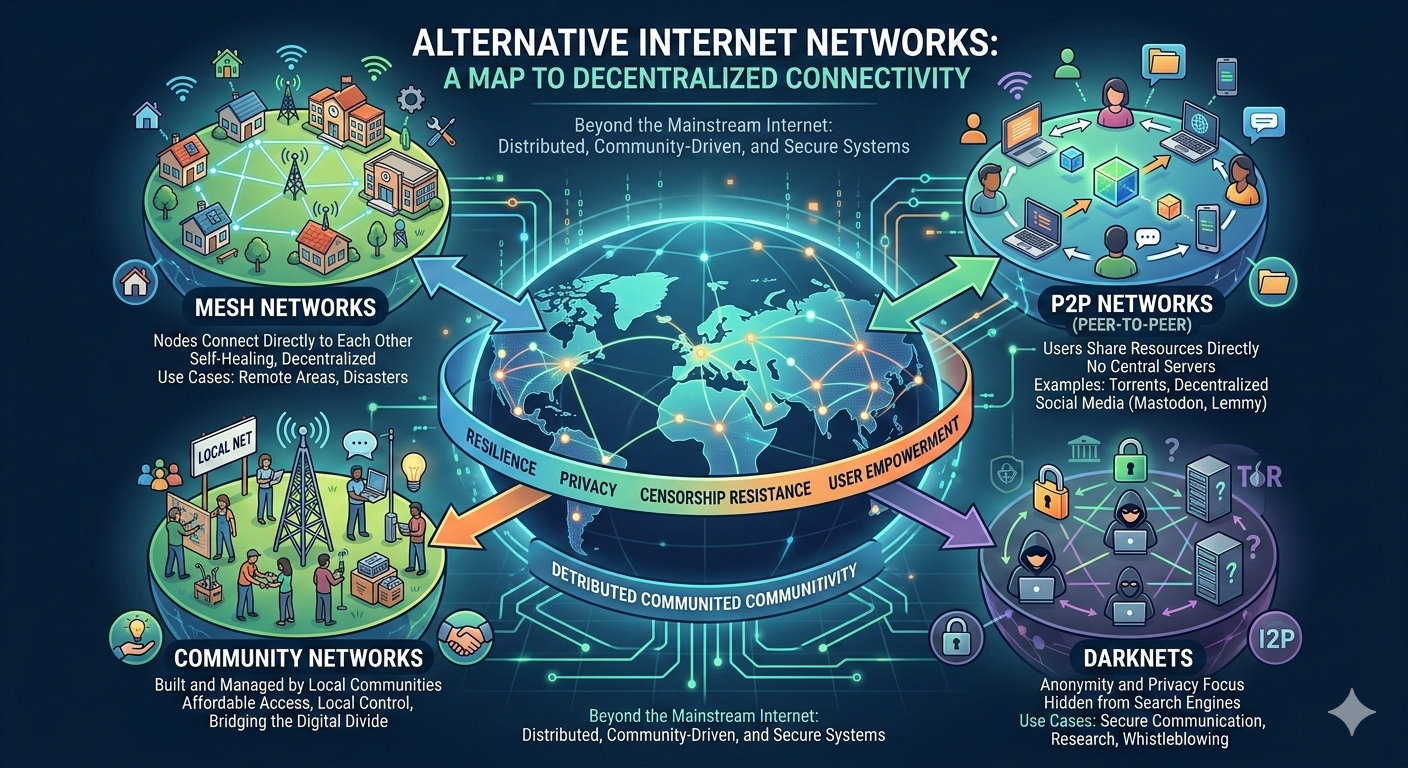
The modern internet is a centralized infrastructure dependent on large ISPs, government regulation, and physical cables. However, alternative approaches to building networks offer greater resilience, privacy, or independence from traditional systems.
1. Mesh Networks
Mesh networks are decentralized networks where every device acts simultaneously as a client and a router. Data hops from node to node without relying on a central server.
Advantages:
- High resilience — if one node fails, traffic reroutes automatically
- Works without traditional ISP infrastructure
- Scales organically as more devices join
Examples: Meshtastic (LoRa-based), goTenna, NYC Mesh, Althea Network
2. Peer-to-Peer (P2P) Networks
P2P networks eliminate the need for central servers by connecting users directly to one another. They are widely used for file sharing, communication, and distributed computing.
Advantages:
- No single point of failure or censorship
- Reduced infrastructure costs
- Greater user control over data
Examples: BitTorrent, IPFS (InterPlanetary File System), Freenet, I2P
3. Satellite Internet
Satellite networks provide internet access from orbit, bypassing ground-based infrastructure entirely. Low Earth Orbit (LEO) constellations have dramatically improved speeds and latency.
Advantages:
- Global coverage, including remote and rural areas
- Independent of local ISP monopolies
- Resilient during terrestrial disasters or conflicts
Examples: Starlink (SpaceX), OneWeb, Amazon Kuiper
4. Community Networks
Community networks are built and operated by local groups, municipalities, or cooperatives rather than commercial providers. They prioritize access, affordability, and local governance.
Advantages:
- Democratic control over network policy
- Often cheaper for end users
- Serves underserved communities
Examples: Guifi.net (Spain), Freifunk (Germany), B4RN (UK)
5. Dark Nets and Overlay Networks
Overlay networks run on top of the existing internet but provide anonymity, censorship resistance, and encrypted communication channels.
Advantages:
- Strong privacy and anonymity
- Resistant to surveillance and blocking
- Accessible even under heavy censorship
Examples: Tor Network, I2P (Invisible Internet Project), ZeroNet, Yggdrasil
6. Ham Radio and Digital Radio Networks
Amateur (ham) radio networks have been used for decades to transmit data without any internet infrastructure at all. Modern digital modes allow email, messaging, and even basic web browsing over radio frequencies.
Advantages:
- Completely independent of internet infrastructure
- Operates during power outages with battery/solar setups
- Long-range communication possible
Examples: Winlink, APRS, JS8Call
7. Li-Fi (Light Fidelity)
Li-Fi transmits data using visible light from LED bulbs instead of radio waves. While still emerging, it offers an interesting complement or alternative to Wi-Fi in specific environments.
Advantages:
- Extremely high bandwidth potential
- No radio frequency interference
- Inherently secure (light doesn’t pass through walls)
Limitations: Requires line-of-sight; limited range
Conclusion
No single alternative can fully replace the traditional internet for all use cases — but together, these technologies offer a more resilient, decentralized, and censorship-resistant communication landscape. As connectivity becomes increasingly critical, understanding and building these alternatives is more important than ever.