How a nation that invented the pre-web built its own rules for the network age
Before the Web, There Was Minitel
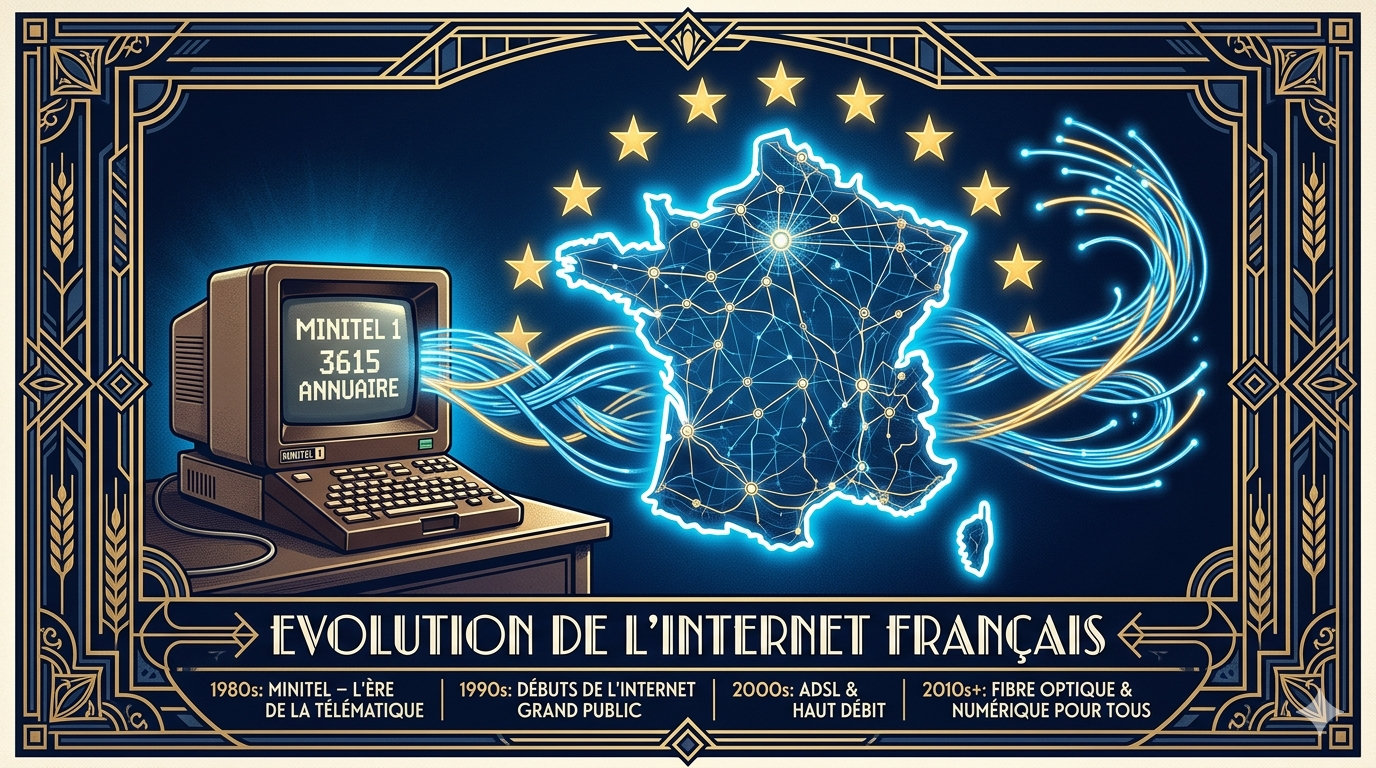
In 1982, while most of the world was still figuring out what a modem was, France launched something remarkable: Minitel. Operated by France Télécom under the state’s Direction Générale des Télécommunications, Minitel was a nationwide videotex network that gave French households a terminal, a phone line, and access to an online world — over a decade before the World Wide Web existed.
At its peak, Minitel had more than 25 million users. You could book train tickets, check the weather, send messages, access the phone directory, and even use adult chat services (the infamous messageries roses) — all from a beige plastic box sitting next to your telephone. Banks, government services, and media outlets all had Minitel portals.
The system was a genuine technological achievement and, in hindsight, a proof of concept for what a nationally managed digital infrastructure could look like. But it was also, paradoxically, the reason France was slow to adopt the Web. Why migrate to the internet when you already had something that worked?
By the time France fully embraced the internet in the late 1990s, Minitel was still processing millions of transactions per year. The service wasn’t finally shut down until June 30, 2012 — the same year the iPhone 5 was released.
The ISP Landscape: Four Players, One Very Competitive Market
France’s internet service provider market is one of the most concentrated — and most competitive — in Europe. Four major operators dominate:
- Orange (formerly France Télécom) — the historical incumbent, privatized in 2004, still the largest player by infrastructure and subscriber base
- SFR (Société Française du Radiotéléphone) — now owned by Altice, covers mobile and fixed broadband
- Bouygues Télécom — part of the Bouygues construction and media conglomerate
- Free (Iliad) — the disruptor, founded by Xavier Niel in 1999, which famously upended the market in 2012 by launching mobile plans at a fraction of competitor prices
The arrival of Free Mobile in January 2012 is often cited as one of the most significant competitive shocks in European telecom history. Within months, SFR and Bouygues were forced to cut prices dramatically. Average revenue per user dropped by 30–40% industry-wide. The French consumer won. The carriers did not.
Today, France consistently ranks among the top European countries for broadband speed and price-to-value ratio. The national fiber rollout (Plan France Très Haut Débit) aims to bring fiber-to-the-home (FTTH) to all of France by 2025, a target the country is largely on track to meet outside rural areas.
Digital Sovereignty: France’s Biggest Internet Obsession
If you follow European tech policy, you’ve likely encountered the phrase souveraineté numérique — digital sovereignty. France didn’t invent the concept, but it has made it its own.
The anxiety is not abstract. French politicians and tech strategists have spent years watching American platforms — Google, Meta, Amazon, Microsoft — accumulate dominant positions in search, social media, cloud, and advertising. European alternatives have struggled to compete at scale. The question for Paris has been: what does it mean to be “sovereign” in a networked world dominated by infrastructure and platforms you don’t control?
GAIA-X and the Cloud Question
France was a driving force behind GAIA-X, the European initiative launched in 2020 to create a federated, standards-based cloud infrastructure with European governance. The French government has co-invested with Germany and the European Commission to define a model where cloud data — especially sensitive public sector data — doesn’t have to traverse American legal jurisdiction.
In practice, GAIA-X has struggled to deliver on its ambitious goals. The initiative has been criticized for being too bureaucratic, too slow, and — ironically — for welcoming American hyperscalers like AWS, Microsoft Azure, and Google Cloud as members. The gap between the political vision and the technical reality has been wide.
Still, France has pushed ahead with specific national measures. The Doctrine Cloud au Centre policy, adopted in 2021, requires French public administrations to store sensitive data exclusively with “trusted cloud” providers — a label that requires, among other things, no vulnerability to American CLOUD Act requests. So far, only a handful of French and European providers have qualified.
The DSA and France’s Regulatory Ambitions
France was among the most vocal advocates for the EU’s Digital Services Act (DSA), which came into full effect in February 2024. The DSA imposes obligations on large platforms regarding content moderation, algorithm transparency, and systemic risk assessments. For France, it’s part of a broader project: using Brussels as a lever to impose European standards on global platforms that French law alone couldn’t reach.
The French digital regulator, Arcom (formerly CSA), now plays an active role in overseeing DSA implementation domestically. France has also pushed for stronger enforcement of the droit à l’oubli (right to be forgotten) and has been an aggressive litigant in data protection cases through the CNIL, the national privacy authority.
The Cultural Dimension: French Exceptionalism, Online
France’s approach to the internet is inseparable from its broader cultural politics. The country has a long tradition of protecting French language and culture from what politicians call “Anglo-Saxon” cultural domination — a concern that predates the internet by decades.
The loi Toubon of 1994 mandated the use of French in official communications, advertising, and government documents. In the early internet era, France attempted (largely unsuccessfully) to require French-language interfaces and content. The debate continues today in milder forms: the Académie française still issues official French alternatives to tech terminology (courriel for email, logiciel for software, nuage for cloud).
French news publishers have been among the most assertive in demanding compensation from platforms that display snippets of their content. France was the first country to enforce the EU’s neighbouring rights (droits voisins) framework against Google, resulting in a landmark agreement in 2021 where Google committed to negotiate payment deals with French publishers — a model that has since been replicated in other European countries.
Where France Stands Today
France occupies an unusual position in the global internet landscape. It has produced major digital companies — Dassault Systèmes, Capgemini, Criteo, OVHcloud, Doctolib — but not a global consumer platform to rival the American or Chinese giants. The French Tech ecosystem in Paris is genuinely vibrant, with a growing startup scene and strong engineering talent. But the ambition to build a European alternative to Silicon Valley remains more aspiration than reality.
What France has built is a coherent regulatory and political philosophy about how the internet should be governed: as a space where public interest, privacy, cultural diversity, and democratic accountability matter alongside innovation and market efficiency.
Whether that philosophy scales beyond French borders — and whether it can shape the global internet in meaningful ways — is the central open question of French digital policy for the decade ahead.
From the beige terminals of Minitel to the Brussels negotiating rooms where DSA enforcement is litigated, France has never been a passive participant in the story of the internet. It has been, consistently, a country that wanted the network to work on its own terms.