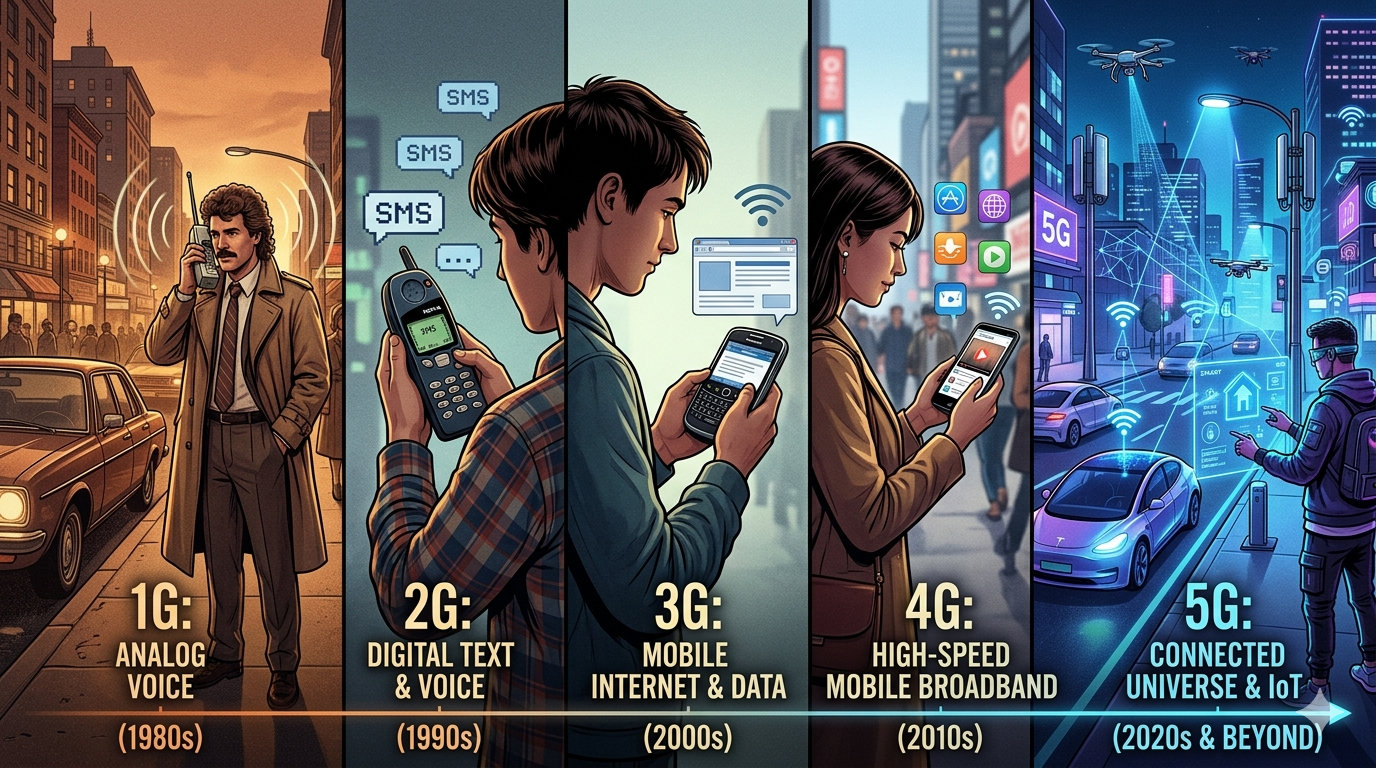
Mobile communications have transformed human society more profoundly than almost any other technology of the 20th and 21st centuries. What began as a bulky, expensive privilege for a handful of business executives has become a universal infrastructure layer that billions of people rely on every day — for calls, messaging, banking, navigation, entertainment, and increasingly for critical IoT systems. This article traces the evolution of cellular networks from their analog origins to the hyperconnected era of 5G.
The Foundation: How Cellular Networks Work
Before diving into generations, it helps to understand the basic architecture shared by all cellular systems.
A cellular network divides a geographic area into overlapping hexagonal zones called cells. Each cell is served by a base station (also called a cell tower or NodeB/gNB in modern terminology) that handles radio communication with devices in its coverage area. Base stations are connected to the core network — the backbone infrastructure responsible for routing calls, managing authentication, billing, and interconnecting with other networks (including the internet and PSTN).
Key concepts common to all generations:
- Frequency spectrum — Radio frequencies allocated by governments to mobile operators, measured in MHz or GHz. Lower frequencies travel farther and penetrate buildings better; higher frequencies carry more data but have shorter range.
- Handover (handoff) — The process of transferring an active connection from one base station to another as the user moves.
- Multiplexing — Techniques for sharing a frequency band among many users simultaneously (TDMA, CDMA, OFDMA).
- Duplex — How uplink and downlink are separated: FDD (Frequency Division Duplex) uses separate frequency bands; TDD (Time Division Duplex) alternates transmission direction on the same frequency.
1G — The First Generation (1979–1990s)
Overview
First-generation networks introduced analog radio technology for voice communication. The concept of cellular networking was developed at Bell Labs in the 1970s, and the first commercial deployment was NTT’s system in Japan in 1979. The United States followed with AMPS (Advanced Mobile Phone System) in 1983.
Key Standards
| Standard | Region | Launch Year |
|---|---|---|
| NTT | Japan | 1979 |
| NMT 450/900 | Scandinavia, Europe | 1981 |
| AMPS | USA | 1983 |
| TACS | UK, Europe | 1985 |
| C-450 | Germany | 1985 |
Characteristics
- Modulation: Analog FM (frequency modulation)
- Voice only — no data services
- Speed: N/A (voice circuit-switched)
- Frequency bands: 450 MHz, 800–900 MHz
- Security: Essentially none — calls could be intercepted with a radio scanner
- Roaming: Limited; incompatible national standards prevented international roaming
- Handsets: Large, heavy, expensive (often car-mounted)
Limitations
The analog nature of 1G made eavesdropping trivial. Capacity was severely limited. Call quality degraded noticeably at cell edges. Fraud was rampant — cloning a phone’s identity was relatively straightforward. These shortcomings drove the rapid development of digital second-generation systems.
2G — Digital Voice and the Birth of SMS (1991–2000s)
Overview
The second generation marked the shift from analog to digital transmission. Digitizing voice signals immediately improved call quality, spectral efficiency, and security. It also opened the door to data services — most famously, SMS (Short Message Service), which became a cultural phenomenon worldwide.
Key Standards
GSM (Global System for Mobile Communications) emerged as the dominant 2G standard globally, developed by ETSI and first deployed commercially in 1991 in Finland. Its wide adoption created the first truly international roaming ecosystem.
CDMA (IS-95 / cdmaOne) was the competing standard in the Americas and parts of Asia, developed by Qualcomm. Rather than dividing the spectrum by time slots (TDMA) like GSM, CDMA assigned each user a unique spreading code, allowing simultaneous transmission across the full frequency band.
| Standard | Multiple Access | Primary Region |
|---|---|---|
| GSM 900/1800 | TDMA + FDMA | Europe, Asia, Africa |
| IS-95 (cdmaOne) | CDMA | Americas, Korea |
| PDC | TDMA | Japan |
| D-AMPS (IS-136) | TDMA | Americas |
2.5G and 2.75G — Stepping Toward Data
As demand for mobile data grew, the industry introduced intermediate technologies:
- GPRS (General Packet Radio Service) — dubbed “2.5G,” introduced packet-switched data over GSM. Speeds: 56–114 kbps.
- EDGE (Enhanced Data rates for GSM Evolution) — “2.75G,” improved modulation to reach up to 384 kbps. Often the last upgrade step before 3G deployment.
Characteristics
- Modulation: GMSK (GSM), QPSK/BPSK (CDMA)
- Voice: Circuit-switched; digital encoding (codecs)
- Data: Packet-switched (GPRS/EDGE); up to 384 kbps
- Frequency bands: 850, 900, 1800, 1900 MHz
- Security: Encryption (A5/1, A5/2 algorithms in GSM); SIM card authentication
- SMS: Introduced and became globally ubiquitous
- MMS: Multimedia Messaging Service (images, short audio)
Legacy
GSM remains operational in many parts of the world decades after its introduction. Its SIM (Subscriber Identity Module) concept — separating subscriber identity from the hardware — proved so successful it lives on in every subsequent generation. In many developing nations, 2G still serves as the primary connectivity layer for voice and basic data.
3G — Mobile Broadband Arrives (2001–2010s)
Overview
The ITU’s IMT-2000 framework defined requirements for third-generation networks, with a key target of 2 Mbps for stationary users. 3G transformed mobile phones from communication tools into pocket computers. The launch of the Apple iPhone in 2007 (initially on EDGE, then 3G) demonstrated the transformative potential of mobile internet and accelerated 3G adoption globally.
Key Standards
UMTS/WCDMA (Universal Mobile Telecommunications System) was the 3G evolution path for GSM operators, standardized by 3GPP. It used Wideband CDMA (WCDMA) as its radio interface.
CDMA2000 was the 3G evolution for IS-95 operators, developed in parallel by 3GPP2.
TD-SCDMA was a Chinese standard developed by CATT/Datang, notable for its use of TDD and low chip rate — aimed at reducing dependence on Western IP.
| Standard | Evolution From | Primary Region |
|---|---|---|
| UMTS/WCDMA | GSM | Global |
| CDMA2000 1x | IS-95 | Americas, Korea |
| EV-DO (Rev. A/B) | CDMA2000 | Americas, Korea |
| TD-SCDMA | — | China |
HSPA — 3.5G and Beyond
HSDPA (High-Speed Downlink Packet Access) and HSUPA (High-Speed Uplink Packet Access), collectively HSPA, dramatically improved 3G speeds within the same spectrum. HSPA+ pushed practical speeds even further.
| Technology | Max Downlink | Max Uplink |
|---|---|---|
| WCDMA R99 | 384 kbps | 384 kbps |
| HSDPA | 14.4 Mbps | 384 kbps |
| HSUPA | 14.4 Mbps | 5.76 Mbps |
| HSPA+ | 42–168 Mbps | 22–69 Mbps |
Characteristics
- Radio access: WCDMA (5 MHz channel), EV-DO (1.25 MHz)
- Core network: Packet-switched IP; circuit-switched voice retained
- Frequency bands: 850, 900, 1700, 1900, 2100 MHz
- Latency: 100–500 ms (UMTS); ~70 ms (HSPA+)
- Security: Mutual authentication (network authenticates device AND device authenticates network — fixing a 2G vulnerability)
- Video calling: Introduced as a mainstream feature
- App stores / mobile internet: Became practical realities
4G LTE — The All-IP Era (2009–Present)
Overview
Fourth-generation networks completed the transition to a fully packet-switched, all-IP architecture. LTE (Long-Term Evolution), standardized by 3GPP in Release 8 (2008) and first deployed commercially in December 2009 in Norway and Sweden by Telia and TeliaSonera, delivered a step-change improvement in both speed and latency. The parallel standard WiMAX (IEEE 802.16e) competed briefly before the industry converged on LTE.
“True 4G” by ITU’s IMT-Advanced specification required 100 Mbps for high-mobility and 1 Gbps for low-mobility scenarios. While early LTE deployments fell short of these targets, LTE-Advanced (Release 10, 2011) met the criteria through carrier aggregation and advanced antenna techniques.
Key Technologies in LTE
OFDMA (Orthogonal Frequency Division Multiple Access) — The fundamental radio access technology. Splits the spectrum into many narrow subcarriers (15 kHz each), assigning groups of subcarriers to individual users. Highly resistant to multipath interference.
MIMO (Multiple Input Multiple Output) — Uses multiple antennas at both transmitter and receiver to multiply throughput. LTE started with 2×2 MIMO; LTE-Advanced introduced 4×4 and 8×8 configurations.
Carrier Aggregation (CA) — Combines multiple LTE frequency bands (called component carriers) to increase total bandwidth. LTE-Advanced allows up to 5 component carriers (100 MHz total).
eICIC (enhanced Inter-Cell Interference Coordination) — Enables heterogeneous networks (HetNets) combining macrocells, small cells, picocells, and femtocells.
LTE Variants and Evolutions
| Technology | 3GPP Release | Peak Downlink | Key Feature |
|---|---|---|---|
| LTE | Rel. 8 | 300 Mbps | Baseline 4G |
| LTE-Advanced | Rel. 10 | 1 Gbps | Carrier Aggregation, 8×8 MIMO |
| LTE-Advanced Pro | Rel. 13–14 | 3 Gbps | Licensed-Assisted Access, Massive MIMO |
| NB-IoT | Rel. 13 | 250 kbps | Low-power IoT on LTE |
| LTE-M (eMTC) | Rel. 13 | 1 Mbps | IoT with mobility support |
| VoLTE | Rel. 10 | — | Voice over LTE (IMS-based) |
Characteristics
- Architecture: Flat, all-IP (eNodeBs connect directly to EPC core)
- Core network: EPC (Evolved Packet Core)
- Frequency bands: 700, 800, 850, 900, 1800, 1900, 2100, 2300, 2600 MHz (and more)
- Duplex: FDD and TDD variants
- Channel bandwidths: 1.4, 3, 5, 10, 15, 20 MHz
- Typical latency: 30–50 ms
- Peak theoretical speeds: Up to ~3 Gbps (LTE-Advanced Pro)
- Real-world speeds: 20–150 Mbps (highly dependent on congestion, distance, band)
Impact
LTE enabled the smartphone revolution to reach its full potential. HD video streaming, cloud gaming, real-time navigation, video conferencing, and app ecosystems all became routine mobile activities. VoLTE replaced circuit-switched voice with HD voice over the packet network. LTE also became the foundation for the first wave of IoT deployments.
5G — The Connected Intelligence Era (2019–Present)
Overview
5G (Fifth Generation), standardized in 3GPP Release 15 (completed June 2018) and first commercially deployed in 2019, represents a fundamental rethinking of what a mobile network is. Rather than simply a faster phone network, 5G is designed as a universal connectivity platform for humans, machines, vehicles, and infrastructure alike.
The ITU’s IMT-2020 framework defines three primary use case categories for 5G:
- eMBB (enhanced Mobile Broadband) — Faster, higher-capacity connections for smartphones and fixed wireless access.
- URLLC (Ultra-Reliable Low-Latency Communications) — Sub-millisecond latency and extremely high reliability for autonomous vehicles, industrial automation, remote surgery.
- mMTC (massive Machine-Type Communications) — Supporting up to 1 million connected devices per km² for IoT deployments.
Key Technologies in 5G
NR (New Radio) — The 5G radio access technology, standardized by 3GPP. Supports far wider frequency ranges than LTE and introduces more flexible slot structures (numerology).
mmWave (millimeter wave) — Frequencies above 24 GHz (FR2: 24.25–52.6 GHz). Enables extremely high throughput (multi-Gbps) in dense urban areas but has very limited range and poor building penetration. Requires dense small cell deployments.
Sub-6 GHz (FR1: 410 MHz–7.125 GHz) — The primary workhorse band for nationwide 5G coverage, balancing range and capacity. Includes both mid-band (2.5–3.7 GHz) and low-band (600–900 MHz).
Massive MIMO — Arrays of 64–256+ antenna elements at base stations, using beamforming to direct energy precisely toward individual users rather than broadcasting in all directions.
Beamforming & Beam Management — Dynamically steers narrow radio beams toward users, improving signal quality and reducing interference.
Network Slicing — Virtualizes the network into multiple logical “slices,” each with customized QoS parameters. A slice for emergency services can have guaranteed latency and bandwidth independent of consumer traffic.
5G Core (5GC) — A cloud-native, service-based architecture (SBA) replacing the EPC. Functions are microservices communicating via REST APIs, enabling flexible deployment on commercial cloud infrastructure.
MEC (Multi-access Edge Computing) — Brings compute resources to the network edge (at or near base stations), reducing round-trip latency for latency-critical applications.
5G Frequency Ranges
| Range | Frequencies | Characteristics |
|---|---|---|
| Low-band (FR1 sub-1GHz) | 600–900 MHz | Wide coverage, low capacity |
| Mid-band (FR1 1–7 GHz) | 2.5–3.7 GHz | Balance of coverage and capacity; “sweet spot” |
| mmWave (FR2) | 24–52 GHz | Ultra-high capacity, very short range |
Deployment Modes
- NSA (Non-Standalone) — 5G NR radio is anchored to 4G LTE core (EPC). Faster to deploy; leverages existing LTE infrastructure. Used in most early deployments.
- SA (Standalone) — Full 5G NR + 5G Core deployment. Enables all advanced 5G features (network slicing, URLLC, full edge computing). Migration ongoing globally.
IMT-2020 Target Characteristics
| Parameter | 4G LTE-A (Peak) | 5G IMT-2020 Target |
|---|---|---|
| Peak downlink speed | 1 Gbps | 20 Gbps |
| Peak uplink speed | 500 Mbps | 10 Gbps |
| User experience downlink | 10 Mbps | 100 Mbps |
| Latency (air interface) | ~4 ms | 1 ms (URLLC) |
| Connection density | 100k/km² | 1M/km² |
| Mobility support | 350 km/h | 500 km/h |
| Energy efficiency | Baseline | 100× improvement |
| Spectrum efficiency | Baseline | 3× improvement |
5G Release Roadmap
| Release | Year | Key Additions |
|---|---|---|
| Rel. 15 | 2018 | 5G NR baseline (NSA + SA), eMBB |
| Rel. 16 | 2020 | URLLC, V2X (vehicle-to-everything), IAB (Integrated Access Backhaul) |
| Rel. 17 | 2022 | RedCap (Reduced Capability) for IoT, NR-NTN (satellite integration) |
| Rel. 18 (5G-Advanced) | 2024 | AI/ML integration, XR optimization, uplink enhancements |
Comparative Summary Across Generations
| Feature | 1G | 2G | 3G | 4G LTE | 5G |
|---|---|---|---|---|---|
| Launch year | 1979 | 1991 | 2001 | 2009 | 2019 |
| Signal type | Analog | Digital | Digital | Digital | Digital |
| Multiple access | FDMA | TDMA/CDMA | WCDMA/CDMA | OFDMA | OFDMA/NOMA |
| Peak speed | — | 384 kbps | 42 Mbps+ | 1–3 Gbps | 20 Gbps |
| Typical latency | — | 300–1000 ms | 100–500 ms | 30–50 ms | <1 ms |
| Core architecture | Circuit | Circuit + Packet | Circuit + Packet | All-IP (EPC) | Cloud-native (5GC) |
| Services | Voice | Voice, SMS, basic data | Voice, video, mobile internet | HD video, VoIP, IoT | eMBB, URLLC, mMTC |
| Spectrum | 450–900 MHz | 850–1900 MHz | 850–2100 MHz | 700–2600 MHz | 600 MHz–52 GHz |
IoT-Specific Network Types
As networks evolved, specialized variants emerged to serve machine-to-machine and IoT use cases:
- NB-IoT (Narrowband IoT) — Uses 180 kHz of LTE spectrum; optimized for battery-powered sensors transmitting small amounts of data infrequently. Battery life up to 10+ years.
- LTE-M (LTE-MTC / Cat-M1) — Higher capability than NB-IoT; supports voice and mobility. Used for wearables, asset trackers.
- EC-GSM-IoT — IoT overlay on existing 2G GSM infrastructure; low deployment cost in regions where GSM is dominant.
- 5G RedCap (Reduced Capability, Rel. 17) — A new 5G device class between LTE-M and full 5G NR, targeting industrial sensors and wearables that don’t need multi-Gbps speeds but benefit from 5G’s other features.
Looking Ahead: 6G on the Horizon
Research into 6G is already underway at academic institutions, standards bodies, and companies worldwide. While no formal standards exist yet, anticipated characteristics include:
- Operation in terahertz (THz) frequencies (100 GHz–10 THz)
- Peak speeds potentially in the range of 1 Tbps
- Sub-100 microsecond latency
- AI-native network architecture — intelligence embedded at every layer
- Integrated sensing and communication — the network as a perception system
- Seamless integration of terrestrial and non-terrestrial networks (satellites, UAVs)
- Commercial deployments tentatively targeted for the early 2030s
Conclusion
The evolution from 1G to 5G spans roughly five decades of continuous innovation — from analog car phones to a programmable, virtualized connectivity fabric underpinning global digital society. Each generation solved the critical limitations of its predecessor while opening entirely new use cases that its designers could barely anticipate.
The defining pattern is clear: each successive generation is not merely an incremental upgrade but a structural reimagining of what a mobile network is for. 1G connected voices. 2G connected people with text. 3G connected people to the web. 4G created the mobile internet economy. 5G is connecting the physical and digital worlds. Whatever 6G ultimately becomes, it will almost certainly expand that boundary further.