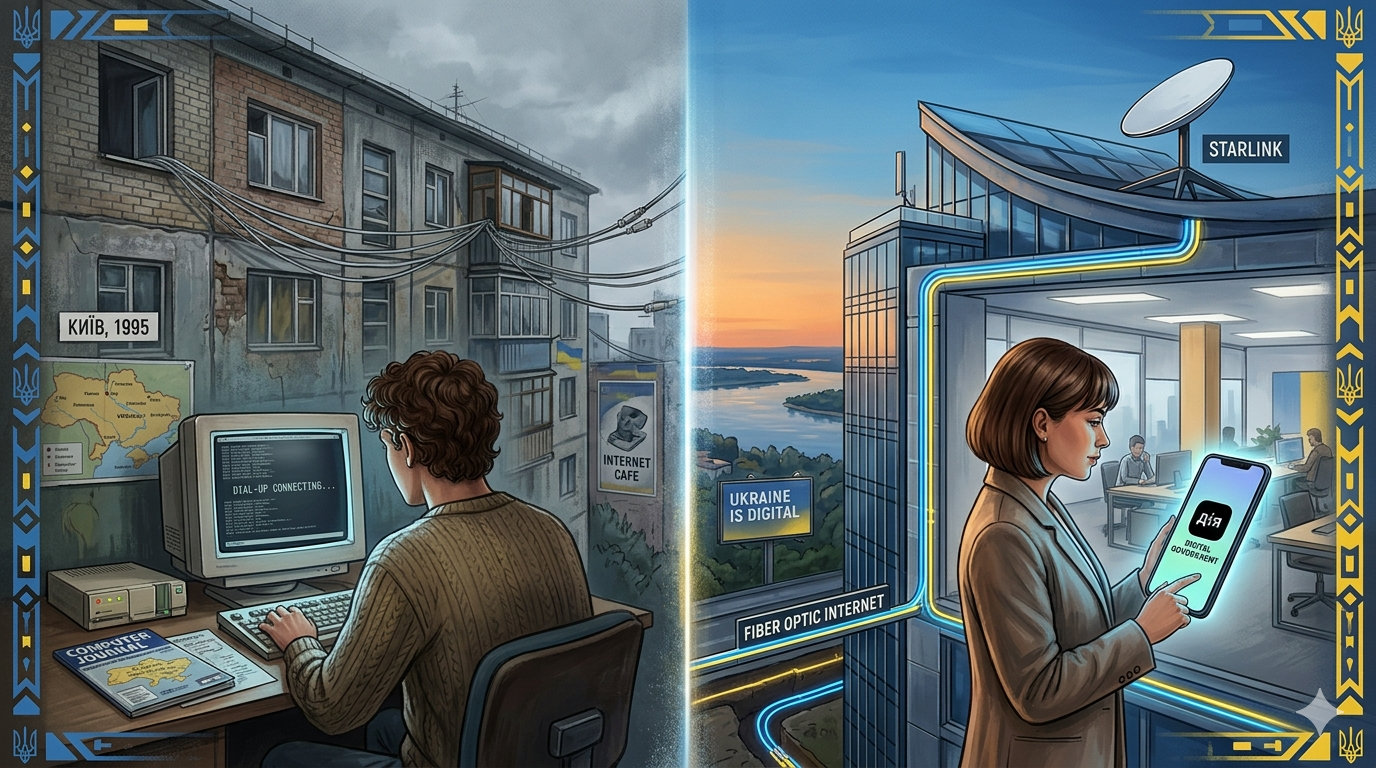
From Soviet Wires to Fiber Revolution
Ukraine’s journey into the digital age is a story of resilience, rapid adaptation, and remarkable growth. From the first experimental connections in the early 1990s to becoming one of Europe’s most connected nations, the development of internet infrastructure in Ukraine reflects both the country’s post-Soviet transformation and its determination to build a modern technological society.
1. The Pre-Internet Era: Academic and Scientific Networks (1980s–early 1990s)
Long before the public internet arrived in Ukraine, scientific institutions were already exploring digital communication. During the late Soviet period, research institutes in Kyiv, Kharkiv, and Lviv experimented with early computer networks to exchange academic data.
The Institute of Cybernetics in Kyiv — founded by the legendary Academician Viktor Glushkov — was a pioneer in computing and networking theory. Glushkov himself proposed a nationwide computer network for the USSR as early as the 1960s, a visionary project that was ultimately shelved for political and economic reasons but planted the intellectual seeds for future development.
By the late 1980s, Ukraine’s academic community was loosely connected through RELCOM (Reliable Communications), a Soviet-era email and Usenet network that ran over telephone lines and represented the first taste of networked communication for Ukrainian researchers.
2. Independence and the First Internet Connections (1991–1995)
Ukraine’s declaration of independence on August 24, 1991 opened new doors — including to the global internet. The transition was chaotic but energetic.
The First Node
The first internet connection in Ukraine is generally traced to 1990–1991, when the Institute of Software Systems of the National Academy of Sciences established a link through Moscow-based RELCOM to the international internet. This connection was narrow — operating at just a few kilobits per second — but it represented an extraordinary leap.
By 1992–1993, Kyiv-based institutions began establishing more direct connections. The Ukrainian Academic and Research Network (URAN) project was conceived to create a dedicated backbone for universities and research institutions, modeling itself on similar academic networks in Western Europe.
Early ISPs
Commercial internet service providers appeared remarkably quickly:
- UarNet (1994) — one of the first commercial ISPs in Ukraine, operated by the Ukrainian State Centre of Radio Frequencies.
- SOVAM Teleport — an early joint venture bringing international connectivity.
- Lucky Net — among the earliest private ISPs to offer dial-up access to the general public.
These early services were extraordinarily expensive and slow by today’s standards. A dial-up connection at 9,600 or 14,400 baud cost more than an average monthly salary, limiting internet access to universities, large businesses, and wealthy individuals.
3. Dial-Up Nation: The Late 1990s Expansion
The second half of the 1990s saw a dramatic proliferation of ISPs and a gradual democratization of internet access, even as connection speeds remained painfully slow.
The Phone Line Era
Dial-up modems became the gateway for a generation of Ukrainian internet users. The characteristic screeching sound of a modem handshake became familiar in apartments across Kyiv, Kharkiv, Odesa, and Lviv. Users typically paid per minute of connection, leading to a culture of downloading web pages, reading them offline, and carefully rationing online time.
By 1997–1998, Ukraine had dozens of commercial ISPs competing for customers. Kyiv, as the capital and largest city, developed the most competitive market, while regional centers lagged behind — a digital divide that would persist for years.
Key Milestones of the Late 1990s
| Year | Development |
|---|---|
| 1995 | Launch of the .ua country-code top-level domain |
| 1996 | First Ukrainian web portals and news websites appear |
| 1997 | URAN academic network operational across major universities |
| 1998 | Approximately 200,000 internet users in Ukraine |
| 1999 | First Ukrainian e-commerce and online banking experiments |
The .ua Domain
The registration of the .ua country-code top-level domain (ccTLD) in 1995 was a milestone for Ukrainian internet identity. Administered initially under international oversight and later by the Hostmaster organization, .ua gave Ukrainian websites a distinct national identity online.
4. The Broadband Revolution (2000–2008)
The new millennium brought transformative change to Ukrainian internet infrastructure. Two technologies would reshape the market: ADSL and, uniquely to Ukraine, a homegrown phenomenon — the home network (домова мережа).
The Rise of Home Networks
Perhaps no development is more distinctly Ukrainian in internet history than the “domoví merezhi” (home networks). Starting in the early 2000s, tech-savvy Ukrainians began stringing Ethernet cables between apartments within a single building, then between buildings, creating informal neighborhood networks.
These community networks were often run by enthusiastic young people — sometimes teenagers — who would install cables through stairwells, across rooftops, and between apartment blocks. Members could share files, play multiplayer games, and eventually access the broader internet through a shared connection.
At their peak, cities like Kyiv, Kharkiv, and Dnipro had hundreds of these micro-networks, some connecting thousands of users. While technically informal and legally ambiguous, they provided affordable broadband-speed local connectivity years before commercial providers offered comparable services to residential customers.
Eventually, commercial ISPs absorbed many of these networks, hiring their operators and formalizing the infrastructure — a uniquely Ukrainian path to broadband development.
Commercial Broadband
Alongside the home networks, commercial ADSL services expanded rapidly:
- Ukrtelecom, the state monopoly on telephone infrastructure, rolled out ADSL services from approximately 2003 onward.
- Private ISPs such as Volia, Golden Telecom (later acquired by Kyivstar/Veon), and dozens of regional operators began offering wired broadband.
- Cable TV operators began offering internet access as an additional service.
By 2005, Ukraine had approximately 1.5 million broadband subscribers — modest by European standards but representing explosive growth from near-zero five years earlier.
5. The Orange Revolution and the Internet as Public Space (2004–2010)
The Orange Revolution of 2004 marked a turning point not just for Ukrainian politics but for the role of the internet in public life. For the first time, online forums, email chains, and early blogs played a significant role in organizing and informing civic activity.
The Ukrainian Blogosphere
Ukrainian-language blogging flourished in the mid-2000s. Platforms like LiveJournal (known locally as “ZheZhe”) became vibrant spaces for political commentary, cultural discussion, and civil society organizing. Ukrainian internet culture began to develop its own distinct character — irreverent, politically engaged, and multilingual, blending Ukrainian, Russian, and occasionally other languages.
Social Media Emergence
By 2007–2010, global social platforms were reshaping online behavior:
- VKontakte (VK) — the Russian social network — became enormously popular in Ukraine, partly due to shared language and cultural ties with Russia.
- Odnoklassniki attracted an older demographic.
- Facebook gradually gained traction, particularly among younger, more Western-oriented users and professionals.
- YouTube transformed media consumption habits.
The coexistence of Russian-origin and Western platforms reflected Ukraine’s complex cultural and geopolitical position — a tension that would become increasingly significant in the years ahead.
6. Mobile Internet and the Smartphone Era (2008–2014)
While fixed-line broadband continued to grow, mobile internet emerged as a parallel revolution that would ultimately reach far more Ukrainians.
3G: The Long Wait
Ukraine was notably late in deploying 3G mobile internet compared to its European neighbors. Political disputes, regulatory delays, and conflicts of interest among telecom operators and government officials repeatedly postponed licensing. While most of Europe moved to 3G in 2004–2007, Ukraine’s major operators did not launch commercial 3G services until 2015 — a significant lag.
During this gap, Ukrainians relied on EDGE (2.5G) data services, which offered frustratingly slow speeds for smartphone users. Despite this, smartphone penetration grew rapidly, driven by affordable Android devices.
Wi-Fi Proliferation
In the absence of fast mobile data, Wi-Fi became ubiquitous in Ukrainian cities. Cafés, restaurants, shopping malls, and even public transport introduced free Wi-Fi, creating a culture of seeking out hotspots — a habit born of necessity that persisted even after mobile data improved.
Fixed-Line Modernization
Meanwhile, fixed-line infrastructure continued to improve:
- Fiber-to-the-Building (FTTB) technology spread through apartment blocks, offering speeds of 100 Mbps at increasingly affordable prices.
- ISPs like Kyivstar (mobile), lifecell, and MTS Ukraine (now Vodafone Ukraine) competed intensely on price and speed.
- Ukraine became recognized for having some of the most affordable broadband prices in Europe.
7. The Euromaidan Period and Digital Civic Society (2013–2014)
The Euromaidan protests of 2013–2014 demonstrated the internet’s power as infrastructure for civil society in ways that the Orange Revolution had only hinted at.
The Internet at Maidan
Social media — particularly Facebook and Twitter — played a central role in organizing, documenting, and broadcasting the protests on Maidan Nezalezhnosti in Kyiv. Live streams ran continuously. Citizen journalists documented events in real time. Information spread faster than traditional media could follow.
Mustache (Vusatyi) and other satirical social media accounts attracted hundreds of thousands of followers. Ukrainian internet culture — creative, humor-driven, and politically sharp — came into its own.
Cybersecurity Becomes National Security
The Euromaidan period also brought Ukraine’s first major encounter with state-sponsored cyberattacks. Following Russia’s annexation of Crimea in March 2014 and the outbreak of conflict in eastern Ukraine, Ukrainian government websites, media organizations, and infrastructure faced sophisticated attacks attributed to Russian state actors.
This marked the beginning of Ukraine’s transformation into one of the world’s most cyberattack-tested nations — an experience that would prove invaluable in building cyber resilience.
8. Modernization and the 4G/Fiber Era (2015–2021)
The mid-2010s brought a belated but rapid modernization of Ukrainian telecommunications infrastructure.
3G Finally Arrives — and 4G Follows Quickly
When 3G licenses were finally auctioned and services launched in 2015, the rollout was rapid. Kyivstar, lifecell, and Vodafone Ukraine competed aggressively for subscribers. Within two years, 3G coverage reached the majority of Ukraine’s population.
4G LTE licenses followed in 2018, with commercial services launching that same year — dramatically faster than the gap between 2G and 3G. By 2020, 4G coverage extended to most urban areas and many rural regions.
Fiber Expansion
Simultaneously, fiber-to-the-home (FTTH) deployment accelerated dramatically. Ukraine’s densely packed urban apartment blocks proved ideal for fiber deployment — a single connection point could serve hundreds of households efficiently. ISPs including Triolan, Volia, GigaTrans, and many regional operators rolled out gigabit-capable fiber infrastructure.
By 2020, Ukraine ranked among the top countries globally for affordable broadband speeds, with gigabit internet available in major cities for as little as 150–300 UAH per month (approximately $5–10 USD).
The UTIC and Digital Economy
The Ukrainian tech industry — centered in Kyiv but with significant hubs in Lviv, Kharkiv, Dnipro, and Odesa — grew into a major export earner, dependent on reliable, high-speed internet. The Ukrainian IT sector employed hundreds of thousands of people and contributed billions of dollars annually to the economy, making robust internet infrastructure a matter of national economic importance.
9. Wartime Internet: Resilience Under Attack (2022–Present)
Russia’s full-scale invasion of Ukraine on February 24, 2022 subjected Ukrainian internet infrastructure to unprecedented stress — and demonstrated its remarkable resilience.
The Initial Shock
In the first hours of the invasion, cyberattacks targeted Ukrainian government and financial systems. Physical infrastructure in conflict zones was damaged or destroyed. The cities of Kharkiv, Mariupol, and others saw devastating losses to telecommunications infrastructure.
Starlink and Satellite Connectivity
One of the most significant technological stories of the war was the rapid deployment of SpaceX Starlink satellite internet terminals in Ukraine. Within days of the invasion, Elon Musk announced Starlink activation for Ukraine, and thousands of terminals arrived in the country.
Starlink proved critical for:
- Maintaining government and military communications in areas where terrestrial infrastructure was destroyed
- Enabling continued internet access in frontline communities
- Supporting media and civil society operations
By mid-2022, Ukraine had more active Starlink terminals than any other country in the world.
Infrastructure Resilience
Perhaps most remarkably, Ukrainian internet infrastructure proved far more resilient than many had expected. Several factors contributed:
- Decentralized network topology — years of competition among hundreds of ISPs had created a highly distributed network with no single point of failure
- Rapid community response — ISPs and volunteers worked together to restore connections quickly after damage
- International support — technical assistance and equipment from Western partners helped maintain and restore infrastructure
- Remote work continuity — Ukraine’s large IT sector had infrastructure and experience supporting remote work, which proved essential as millions of Ukrainians relocated
The Digital State
Ukraine’s Diia application — a government digital services platform that allowed citizens to access government documents and services from their smartphones — became a symbol of the country’s digital transformation. Launched in 2020, Diia enabled Ukrainians to use digital versions of passports, driving licenses, and other documents, reducing bureaucratic friction dramatically.
During the war, Diia was used to distribute social assistance payments, process refugee documentation, and maintain government services for millions of displaced Ukrainians — a testament to the value of digital infrastructure built in peacetime.
10. Key Players and Infrastructure Milestones
Major Internet Service Providers
| Company | Type | Notable For |
|---|---|---|
| Kyivstar | Mobile & Fixed | Largest mobile operator, 4G/5G leader |
| Vodafone Ukraine | Mobile | Formerly MTS Ukraine; major 4G provider |
| lifecell | Mobile | Turkish Turkcell subsidiary |
| Ukrtelecom | Fixed | State-owned, national DSL backbone |
| Volia | Fixed | Cable and fiber, major urban ISP |
| Triolan | Fixed | FTTH leader in eastern Ukraine |
| GigaTrans | Backbone | Major transit and peering operator |
The Internet Exchange: UA-IX
The Ukrainian Internet Exchange (UA-IX), established in Kyiv, became one of the most important internet exchange points in Eastern Europe. By facilitating direct peering between Ukrainian ISPs and international networks, UA-IX dramatically reduced latency and improved the quality of internet connections for Ukrainian users, while keeping domestic traffic within the country.
11. Legacy and Lessons
Ukraine’s internet history offers several lessons for the wider world:
Grassroots innovation matters. The home network phenomenon demonstrated that community-driven, informal infrastructure could fill gaps left by slow commercial and government rollout — and could eventually be absorbed and formalized by the market.
Competition drives affordability. Ukraine’s highly competitive ISP market — with hundreds of providers at various times — consistently produced some of Europe’s most affordable broadband prices, challenging the assumption that universal service requires monopoly or heavy state involvement.
Resilience requires diversity. The distributed nature of Ukraine’s internet infrastructure, built through years of competitive development rather than centralized planning, proved to be a strategic asset when war came.
Digital infrastructure is national infrastructure. The role of Diia, Starlink, and internet connectivity in maintaining Ukrainian state function and civil society during wartime demonstrated that internet infrastructure is as vital as roads, power, or water — a lesson with profound implications for national security planning worldwide.
In just three decades, Ukraine transformed from a country with virtually no internet access to one of the world’s most connected and digitally innovative societies. The journey encompassed hand-strung cables in apartment stairwells, a generation of dial-up users, the political awakenings of the Orange Revolution and Euromaidan, and ultimately the extraordinary resilience of a wartime digital state.
Ukraine’s internet story is, in many ways, Ukraine’s modern story: improvised under difficult conditions, driven by creative and determined people, shaped by geopolitical forces, and ultimately proving more resilient than anyone expected.