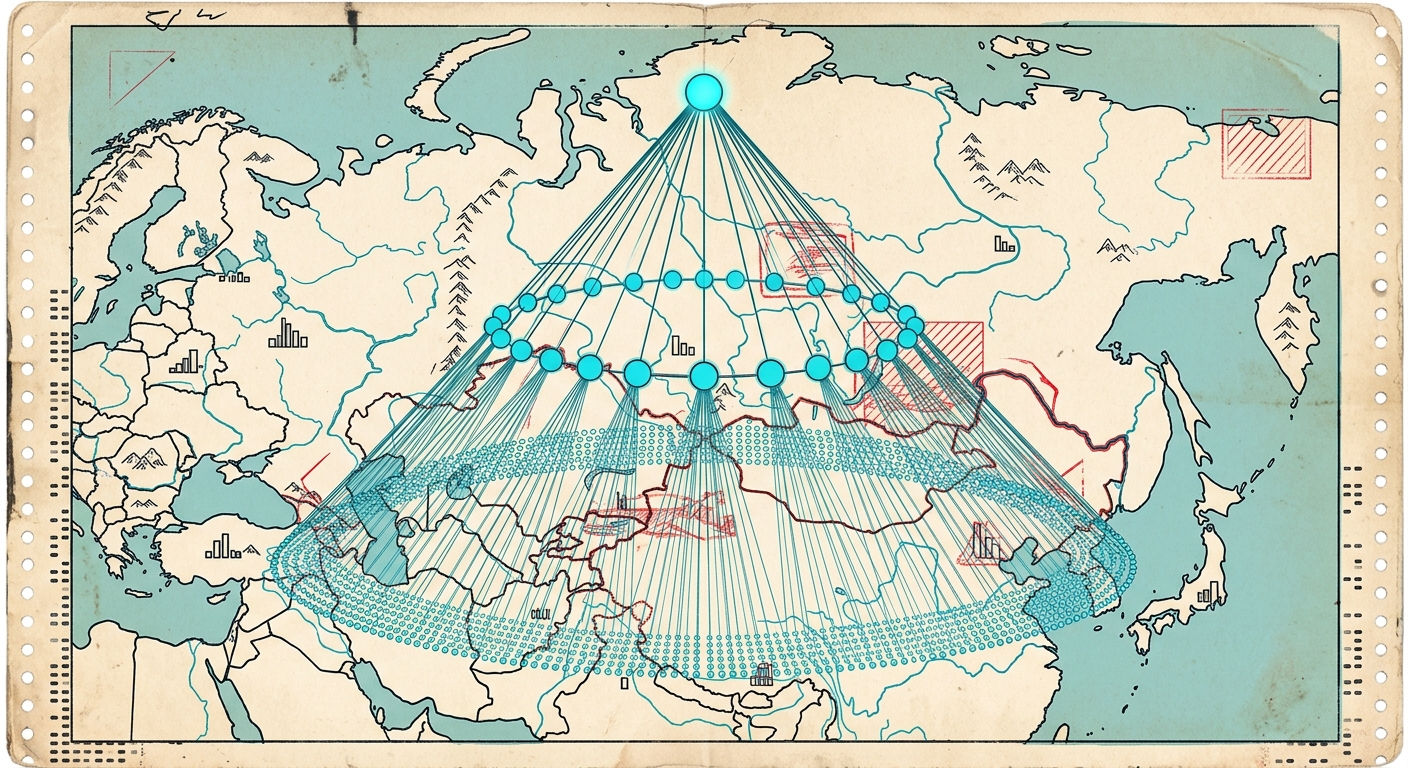
How a Kyiv cyberneticist designed a nationwide computer network in the 1960s, and why it died in a Kremlin meeting room.
On the morning of October 1, 1970, Viktor Glushkov walked into a Politburo meeting in the Kremlin. He had spent eight years preparing for this day. In his briefcase was a plan for the most ambitious computer network anyone had proposed at the time: a system that would link factories, ministries and planning offices across the entire Soviet Union into a single real-time information network.
When he entered the room, he saw two empty chairs. Leonid Brezhnev and Prime Minister Alexei Kosygin, the two most powerful men in the country and his likeliest supporters, were not there.
By the end of the meeting, the project was effectively dead.
Just a year earlier, on the other side of the Iron Curtain, researchers had sent the first message over ARPANET, the network that would eventually grow into the internet. The Soviet Union had its own answer on the table. This is the story of why it never got built.
The problem: an economy drowning in paper
To understand OGAS, you have to understand the problem it was meant to solve.
The Soviet economy was centrally planned. Instead of prices set by markets, planners in Moscow decided what every factory should produce, how much raw material it should receive and where its output should go. Every year, millions of figures about steel, grain, shoes, tractors and trains had to be collected, checked, reconciled and turned into instructions, almost entirely by hand.
As the economy grew, the number of connections between enterprises grew much faster than the number of enterprises themselves. Glushkov did the math and reached an alarming conclusion. In 1962 he estimated that if planning continued to rely on paper-based methods, the administrative apparatus would need to grow by roughly 36 to 40 times by 1980. In other words, in a matter of decades, practically the entire adult population would have to work as planners just to keep the system running.
His solution was not to abandon planning but to automate it: give the economy a nervous system made of computers and telephone lines.
Before Glushkov: the Red Book
Glushkov was not the first to have the idea.
Cybernetics, the science of control and communication in machines and living systems, had a rocky start in the USSR. In the early 1950s, Soviet publications denounced it as a “bourgeois pseudoscience.” After Stalin’s death, a group of scientists worked to rehabilitate the field, and by the late 1950s it had become fashionable, even promising, in official eyes.
One of those scientists was Anatoly Kitov, a military researcher who ran a secret defense computing center. In 1959 he wrote a proposal addressed to Nikita Khrushchev, later known as the “Red Book” letter. Kitov suggested that the army’s powerful computers, which sat largely idle at night, could be used by civilian planners to process economic data. The result would be a dual-use military and civilian network for managing the economy.
The letter never reached Khrushchev. Kitov’s military superiors intercepted it and were furious, both at the idea of sharing military resources and at Kitov’s frank remarks about the state of Soviet computing. He was expelled from the Communist Party and dismissed from the army.
The idea, however, survived. Within a few years it was picked up by a man in Kyiv.
The man from Kyiv
Viktor Mikhailovich Glushkov was born in 1923 in Rostov-on-Don. He trained as a mathematician, made his name in abstract algebra and, in 1956, moved to Kyiv to head a computing laboratory at the Institute of Mathematics of the Ukrainian Academy of Sciences.
It was a laboratory with history. A few years earlier, Sergei Lebedev and his team had built MESM there, the first electronic computer in the Soviet Union and one of the first in continental Europe. Under Glushkov the lab became the Academy’s Computing Center in 1957 and, in 1962, the Institute of Cybernetics, which he directed until his death. Today it bears his name: the V.M. Glushkov Institute of Cybernetics of the National Academy of Sciences of Ukraine.
Glushkov’s institute was an unusual place for the Soviet Union. Its researchers were young, averaging around 25 years old, and they worked on everything from automata theory and computer architecture to early ideas about natural language interfaces and paperless offices. The institute developed the MIR series of computers, small machines designed for engineers that were remarkably user-friendly for their time.
The staff also had a sense of humor. In 1960 they declared themselves citizens of “Cybertonia,” a mock independent country with its own passports, constitution and currency printed on punch cards. Its supreme ruler was a robot that played the saxophone.
Behind the jokes was a serious ambition. Glushkov believed that computers could make socialism work the way it was supposed to.
The blueprint
Glushkov presented his first version of the plan in 1962. Its full name was a mouthful: the All-State Automated System for the Collection and Processing of Information for the Accounting, Planning and Management of the National Economy. Everyone called it OGAS, from its Russian acronym.
The architecture mirrored the structure of the Soviet state itself, in three tiers:
- A central computing center in Moscow at the top.
- Up to about 200 regional centers in major cities in the middle.
- Up to 20,000 local computing centers and terminals at factories and enterprises across the country at the base.
The system would run over existing and newly built telephone lines and process data in real time. Crucially, although the network looked like a pyramid, it was not meant to work like one. Moscow would decide who was authorized to access what, but any authorized node could communicate with any other node directly, without routing every request through the center. For a project born inside a highly centralized state, it was a surprisingly decentralized design.
The scale was staggering. Glushkov expected the network to be built in stages over roughly three decades. According to later accounts, he estimated the cost at no less than 100 billion rubles, an enormous sum, but argued that it would repay itself several times over within the first 15 years through efficiency gains.
He also proposed something that sounds strikingly modern: replacing cash with electronic payments. Citizens’ incomes and purchases would be recorded as entries in a digital ledger. Glushkov, who could quote Marx from memory, pitched this as a step toward the moneyless society Marxist theory promised. The Party officials who reviewed it were less enthusiastic, and the electronic money idea was quietly shelved.
Enemies in the corridors
Through the 1960s, OGAS moved slowly through the Soviet bureaucracy. The project was classified, studied, revised and re-studied. Glushkov traveled between Kyiv and Moscow so often that he joked the overnight train was his second home.
The opposition he faced was not mainly ideological. It was institutional.
OGAS threatened almost everyone who held power in the economic system. Ministries guarded their own data as a source of influence. Factory managers, who routinely padded their reports to secure easier targets and extra supplies, had every reason to fear a system that could see the real numbers. Economists who favored the market-oriented Kosygin reforms of 1965 saw OGAS as a technocratic rival to their own vision. Some liberals worried that such a system would give the state far too much control.
And then there was the question of who would own the project. OGAS was placed under the Central Statistical Administration, which put it in competition with other powerful agencies, above all the Ministry of Finance.
October 1, 1970
That brings us back to the Kremlin.
The minister of finance, Vasily Garbuzov, who held the post for a quarter of a century, went on the attack. He did not argue that computers were useless. Instead, he made the case for modest, practical automation, reportedly pointing to simple computerized equipment he had seen boosting egg production on poultry farms near Minsk. Why fund a vast, speculative national network when small, local improvements could deliver results now?
According to historian Benjamin Peters, there was more going on behind the scenes. Garbuzov had reportedly warned Kosygin privately that if a rival agency kept control of OGAS, his ministry would undermine the project, just as it had helped stall Kosygin’s own economic reforms.
With Brezhnev and Kosygin absent, no one in the room had the authority to overrule him. The Politburo sided with Garbuzov. The next year, the 24th Party Congress endorsed not the national network but only the expansion of local automated management systems at individual enterprises.
Glushkov reportedly warned the leadership that if they did not build the system now, the economic difficulties of the late 1970s would force them to return to the question anyway. He was right about the difficulties. They never did return to the question in the way he hoped.
What happened next
OGAS did not disappear overnight. It fragmented.
Through the 1970s and 1980s, Soviet enterprises and ministries built hundreds of automated management systems, known by the Russian acronym ASU. Glushkov’s own institute developed several of them. But these systems were built by different agencies, on different hardware, to different standards. They could not talk to each other. Instead of a national network, the Soviet Union ended up with an archipelago of isolated computing islands.
Glushkov kept pushing. He promoted a scaled-back version of the network, called EGSVT (the Unified State Network of Computing Centers), but it too was underfunded and never completed. He died in Moscow on January 30, 1982, after a long illness. The New York Times obituary called him the “king of Soviet cybernetics.”
Less than a decade later, the planned economy he had tried to save collapsed along with the Soviet state.
Was OGAS really an “internet”?
It is tempting to call OGAS the Soviet internet, and headlines often do. The comparison is useful, but it needs some care.
| ARPANET | OGAS | |
|---|---|---|
| Main purpose | Sharing scarce computing resources among research institutions | Collecting and processing economic data for state planning |
| Structure | Distributed network of peer nodes | Three-tier hierarchy with direct links between authorized nodes |
| Transmission | Packet switching | Planned to run over telephone lines; not built at scale |
| Funding | Stable funding from the US Department of Defense’s research agency | Never received full approval or funding |
| Users | Researchers, and later a wider academic community | Planners, ministries and enterprises |
| Outcome | Grew into the global internet | Fragmented into incompatible local systems |
The key difference is purpose. ARPANET was built to connect computers so that researchers could share them. OGAS was designed to connect an economy so that it could be planned. It was never intended as a space for free communication between citizens.
What makes OGAS remarkable is the timing and the thinking behind it. In 1962, before ARPANET existed, a team in Kyiv had worked out a design for a nationwide, real-time, remote-access computer network, complete with ideas about decentralized communication and electronic payments.
It is also worth busting a related myth along the way. ARPANET is often said to have been built to survive a nuclear war. In reality, while research on survivable networks influenced its design, ARPANET itself was created mainly to let scientists share computing power. The “Cold War tech race” framing fits the Soviet side of the story rather better: part of the reason the Politburo reviewed OGAS in 1970 was the need to respond to American progress.
A parallel experiment: Chile’s Cybersyn
OGAS was not the only attempt to run an economy with networked computers. In 1971, Salvador Allende’s government in Chile hired the British cybernetician Stafford Beer to build Project Cybersyn. With far fewer resources than the Soviet Union, Cybersyn used a network of telex machines to send daily production data from factories to a futuristic operations room in Santiago.
Cybersyn actually went into partial operation and helped the government coordinate transport during a trucker strike in 1972. It ended abruptly with the military coup of September 1973.
Two countries, two very different political systems, one shared dream: that information technology could make planning faster, smarter and more responsive. Neither dream survived its political circumstances.
Why this story matters today
The easy lesson would be that central planning was doomed and OGAS could never have worked. That may well be true. Even a perfect network cannot fix bad data, and the Soviet economy ran on figures that everyone had reasons to distort. Critics of planning have long argued that no amount of computing power can replace the information that markets generate through prices.
But the story of how OGAS actually died suggests a more interesting lesson.
Historian Benjamin Peters, whose book How Not to Network a Nation is the most detailed study of the project, points out a striking irony. The American network grew out of steady government funding and a cooperative research culture. The Soviet network was killed by fierce competition between ministries, each protecting its own budget and turf. In Peters’ telling, the capitalists behaved like cooperative socialists, while the socialists behaved like competing capitalists.
OGAS failed not because the idea was technically impossible, and not only because of ideology, but because no institution was willing to give up power for a shared system. Great ideas and brilliant engineers are not enough. Networks need institutions that are willing to cooperate.
That lesson has not aged. Today’s internet is increasingly divided into walled gardens, national firewalls and incompatible platforms. The patchwork of isolated Soviet computing islands in the 1980s may be a better picture of our possible future than we would like to admit.
And for anyone walking down Akademika Hlushkova Avenue in Kyiv, past the institute that still carries his name, it is worth remembering: one of the first serious blueprints for a national computer network was drawn up right there.