Tag: internet

  • VPN, Firewall, DDoS: What Actually Protects You Online (And What Doesn’t)

    VPN, Firewall, DDoS: What Actually Protects You Online (And What Doesn’t)

    A no-nonsense guide to network security for people who don’t want a PhD to understand it.

    The Internet Is a Public Road

    Every time you open a browser, send a message, or use an app, your data travels across a network that was originally built for scientists to share research — not for billions of people to do their banking.

    (more…)
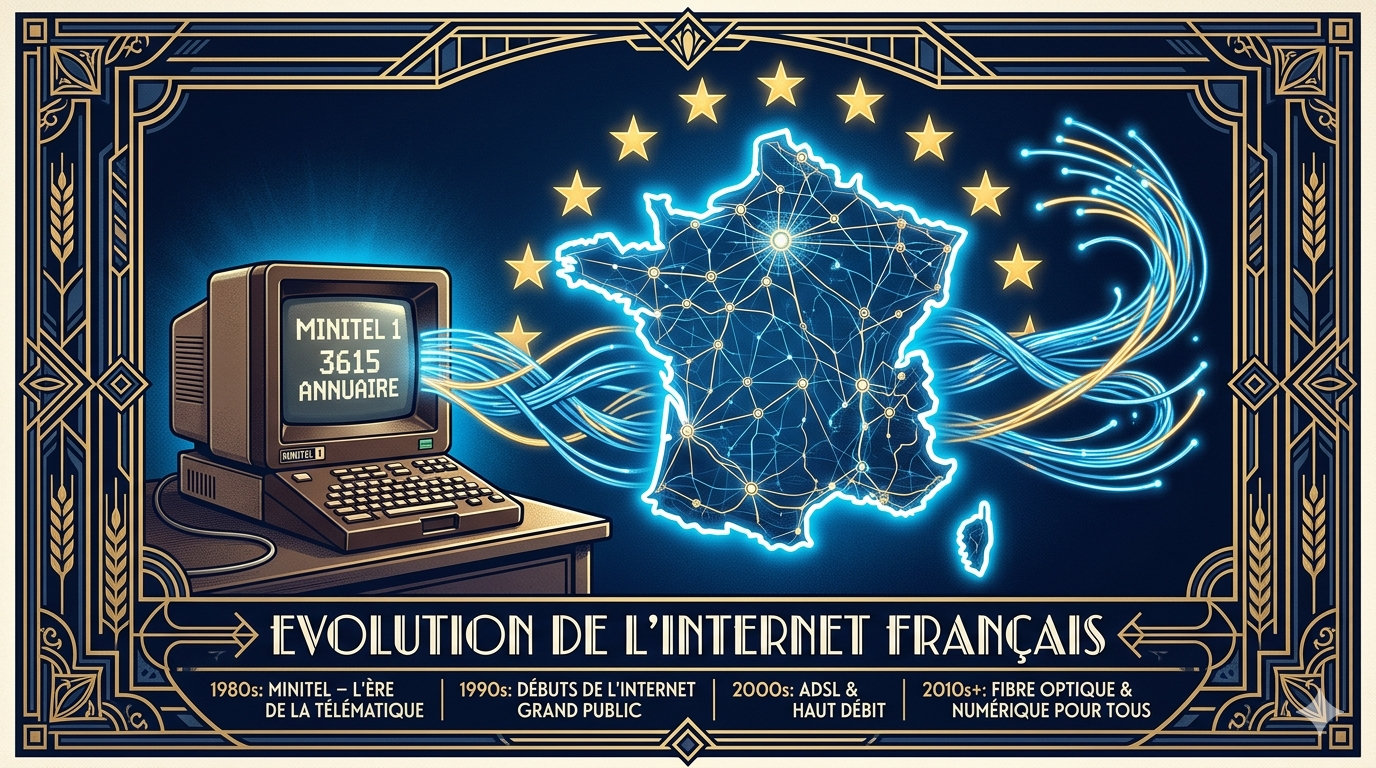
  • France’s Own Internet: From Minitel to Digital Sovereignty

    France’s Own Internet: From Minitel to Digital Sovereignty

    How a nation that invented the pre-web built its own rules for the network age

    Before the Web, There Was Minitel

    In 1982, while most of the world was still figuring out what a modem was, France launched something remarkable: Minitel. Operated by France Télécom under the state’s Direction Générale des Télécommunications, Minitel was a nationwide videotex network that gave French households a terminal, a phone line, and access to an online world — over a decade before the World Wide Web existed.

    (more…)
  • Tales from the Network: True(ish) Stories of Internet Chaos [part 2]

    Tales from the Network: True(ish) Stories of Internet Chaos [part 2]

    Story 4: The 90-Meter Rule

    A company had a mysterious network problem: one specific desk on the third floor could never get a stable connection. The cable was fine. The port was fine. The switch was fine. The NIC was fine. Everything was fine, but nothing worked.

    An old-timer network admin eventually asked: “How long is the cable run from that desk to the patch panel?”

    They measured it. It was 97 meters.

    Ethernet has a maximum run length of 100 meters.

    The desk had been moved — slowly, over the course of several office renovations — further and further from the server room, one meter at a time, across five years, until it quietly and politely fell off the network.

    Nobody moved the desk. They just put a switch under it and called it a day.

    (more…)
  • The Network We Cannot Yet Imagine

    The Network We Cannot Yet Imagine

    There is something quietly strange about the internet. We use it constantly, we depend on it for almost everything, and yet most of us have no idea what it actually is — not the physical reality of it, the cables running along ocean floors, the data centers humming in the desert, the radio waves bouncing between towers and satellites and the small rectangles in our pockets. We interact with a surface, a kind of polished interface on top of an enormous, aging, and deeply complicated machine. And that machine is changing in ways that are hard to fully grasp, even for the people building it.

    (more…)
  • Tales from the Network: True(ish) Stories of Internet Chaos [part 1]

    Tales from the Network: True(ish) Stories of Internet Chaos [part 1]

    Story 1: The Haunted Router

    Dave was a senior network engineer at a mid-sized company. For three weeks, the office Wi-Fi would drop every day — precisely at 2:07 PM. Not 2:06. Not 2:08. Exactly 2:07.

    Dave replaced cables. Dave replaced switches. Dave replaced the router, then replaced it again with a “better” one. He ran packet captures, checked logs, called the ISP twice, and once cried quietly in the server room.

    Finally, in week three, a new intern named Kyle walked over to the kitchen microwave and said:

    “Hey, did you guys know that when Carol heats up her fish every day at lunch, this thing basically broadcasts on the same 2.4 GHz band as your Wi-Fi?”

    Dave never ate in the office again.

    (more…)
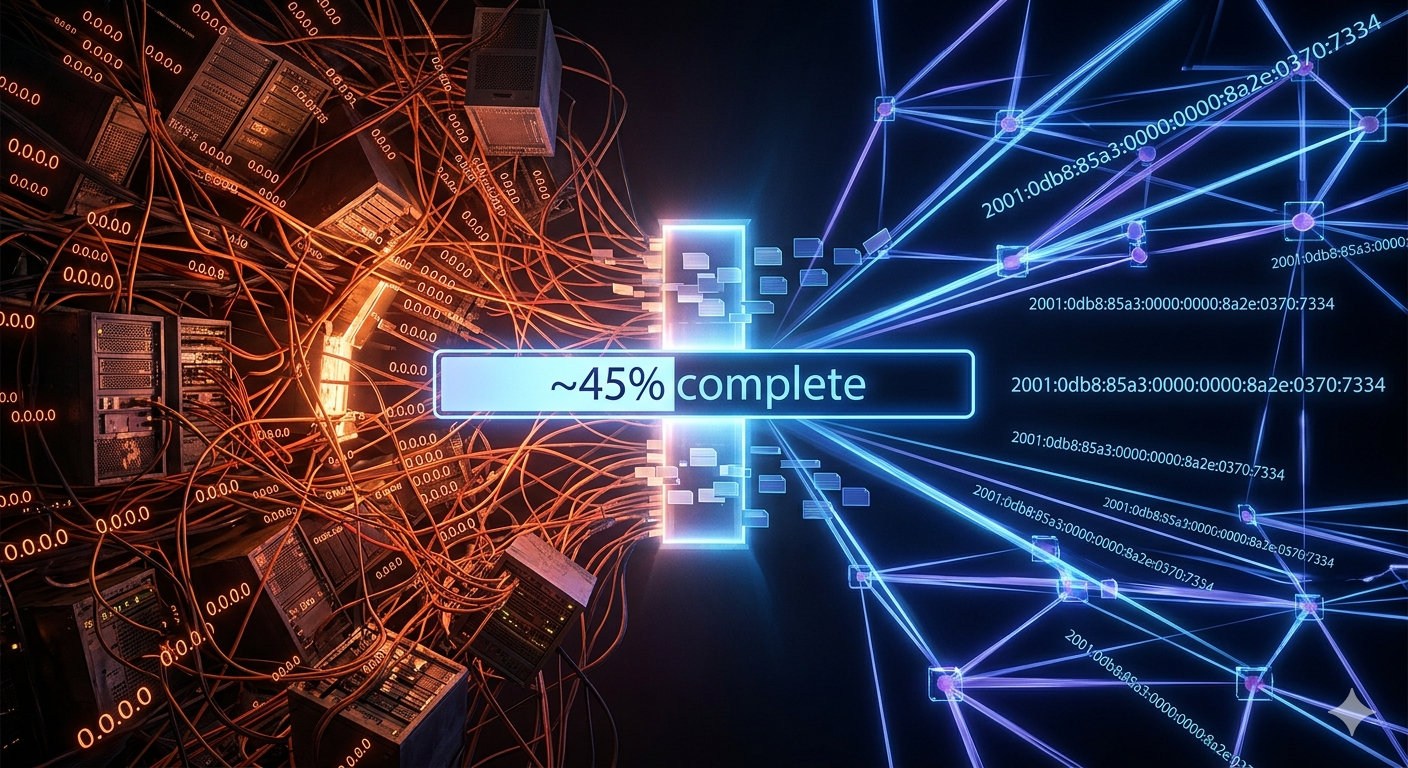
  • IPv6: Why the Transition Is Still Incomplete — and What Lies Ahead

    IPv6: Why the Transition Is Still Incomplete — and What Lies Ahead

    The internet has been “running out of addresses” for decades. The fix has existed since 1998. So why are we still not done?

    The Problem That Was Supposed to Be Solved by Now

    IPv4, the addressing protocol that underpins the modern internet, was designed in 1981 with a pool of roughly 4.3 billion addresses. At the time, that seemed infinite. By the early 1990s, it was clear it wasn’t.

    IPv6 was standardized by the IETF in 1998 (RFC 2460), offering a staggering 340 undecillion addresses — enough for every atom on Earth’s surface to have its own IP. The plan was straightforward: migrate, deprecate IPv4, move on.

    It is now 2026. IPv4 is still the dominant protocol. The transition is, generously, about halfway done.

    This is a story about technical debt, economic incentives, human inertia, and one of the most complex infrastructure migrations in computing history.

    (more…)
  • BGP — The Protocol That Holds the Internet Together

    You use it every time you open a browser. You’ve probably never heard of it. And when it breaks, the internet breaks.

    Introduction

    The internet is not a single network. It’s a vast, chaotic collection of tens of thousands of independent networks — run by ISPs, universities, corporations, cloud providers, and governments — all somehow agreeing to talk to each other. What makes this possible? A single routing protocol called BGP: the Border Gateway Protocol.

    (more…)
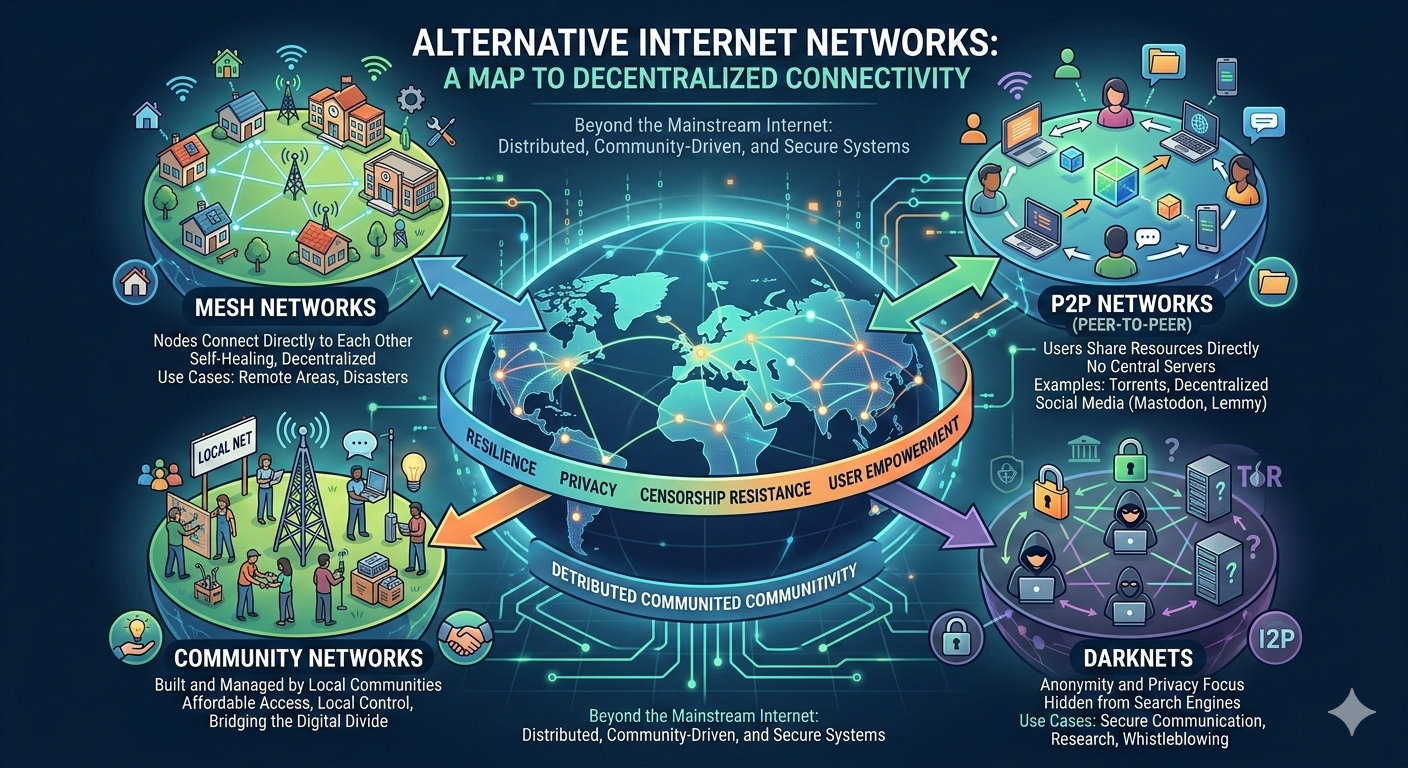
  • Alternative Internet Networks

    Alternative Internet Networks

    The modern internet is a centralized infrastructure dependent on large ISPs, government regulation, and physical cables. However, alternative approaches to building networks offer greater resilience, privacy, or independence from traditional systems.

    (more…)
  • IP Addresses: What They Are and How They Work

    Every time you open a browser, visit a website, send an email, or stream a video, a complex coordination process takes place behind the scenes between millions of devices around the world. At the heart of this coordination is the IP address — a unique identifier without which the modern internet simply could not exist.

    (more…)
  • From Islands of Logic to a Global Web: The Birth of Networking

    In the early days of computing, a computer was an island. It was a massive, room-sized machine that crunched numbers in solitude. If you wanted to share data with another computer, you didn’t send an email; you physically carried a magnetic tape or a stack of punch cards across the room—a method affectionately known as “Sneakernet.”

    The evolution from these digital islands to the hyper-connected world of 2026 is a journey of military necessity, academic curiosity, and a few “Aha!” moments that changed history.

    (more…)