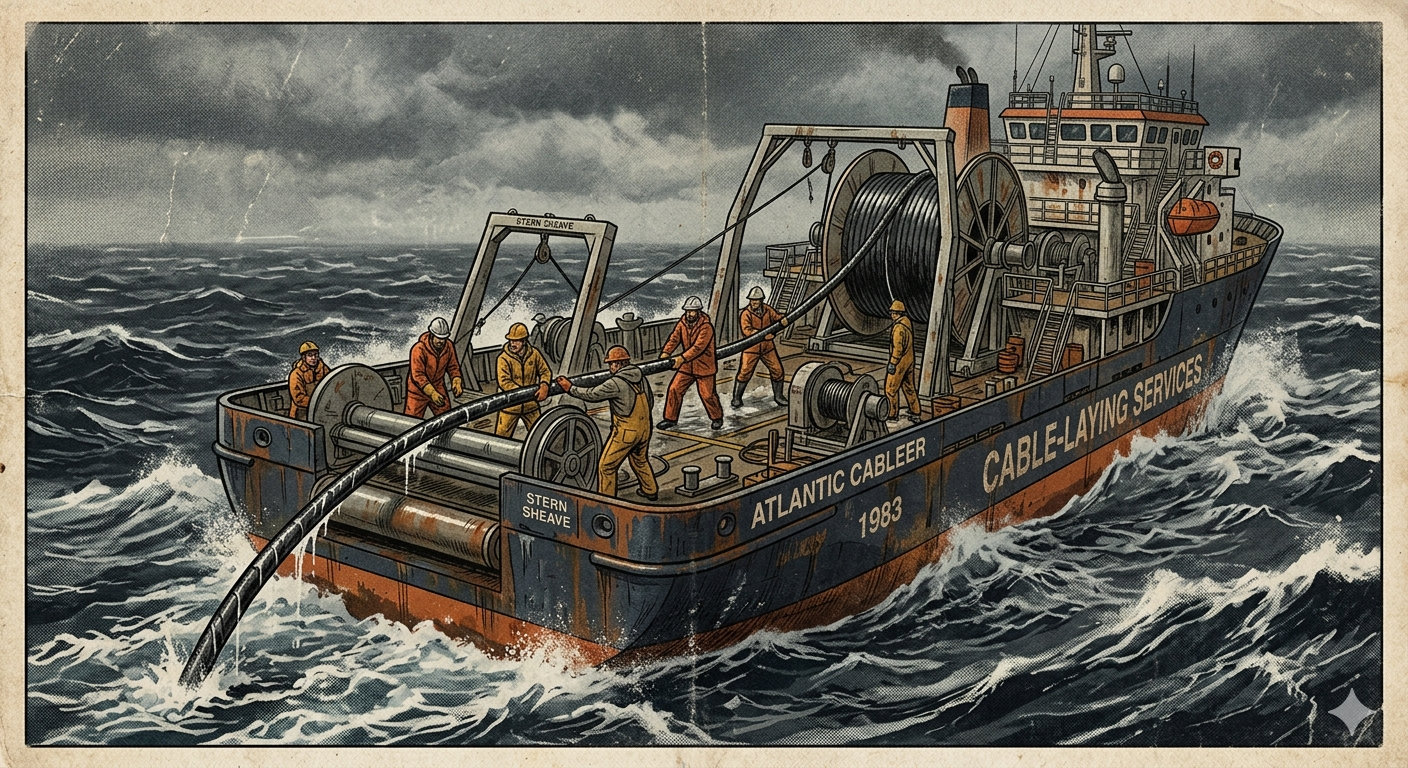
How engineers stretched a wire across 6,000 kilometres of ocean floor — and changed the internet forever.
Before the Wire
In the early 1990s, the internet was growing faster than anyone had anticipated. Universities, research labs, and increasingly — ordinary people — were coming online. But the traffic between Europe and North America still depended on satellite links: expensive, slow, and plagued by the unavoidable physics of signal delay. A round-trip to a geostationary satellite and back takes roughly 600 milliseconds. For email, that was annoying. For real-time communication, it was a wall.
The solution already existed in the form of undersea telephone cables. The first transatlantic telegraph cable had been laid back in 1858. By the 1980s, coaxial cables were carrying phone calls beneath the Atlantic. What the internet needed was something different: fibre optic cables capable of carrying not just voice, but enormous volumes of data at the speed of light.
TAT-8: The Cable That Started It All
The pivotal moment came in 1988, with the laying of TAT-8 — the first transatlantic fibre optic cable.
TAT-8 (Transatlantic Telephone cable number 8) was a joint project between AT&T, British Telecom, and France Télécom. It stretched approximately 6,700 kilometres from Tuckerton, New Jersey, USA, to Widemouth Bay in Cornwall, England, and Penmarc’h in Brittany, France — two branches on the European end, one on the American side.
The cable itself was a marvel of engineering. At its core ran two pairs of single-mode optical fibres, each thinner than a human hair. Light pulses — generated by lasers — would carry data encoded in binary: on, off, on, off, billions of times per second. The initial design capacity was 280 Mbps, enough to handle roughly 40,000 simultaneous telephone conversations. By the standards of anything that had existed before, this was extraordinary.
Engineering the Impossible
Laying an undersea cable is not like running a wire across a room. The Atlantic Ocean is, in places, more than 8 kilometres deep. The cable had to survive crushing pressure, saltwater corrosion, shifting sediment, and the occasional dragged ship anchor or deep-sea trawler.
The cable was manufactured in sections and loaded onto specialised cable-laying ships — enormous vessels equipped with tanks that hold thousands of kilometres of coiled cable. The process of paying out cable required constant coordination between the ship’s navigation team and engineers monitoring cable tension. Too much tension and the cable snaps; too little and it piles up on the seabed in dangerous slack.
Near the shore, where the cable is most vulnerable, it was buried beneath the seabed using underwater ploughs — remotely operated machines that cut a trench, thread the cable through, and let the sediment settle back over it. In deeper water, where anchors and trawling gear can’t reach, the cable rests freely on the ocean floor.
Along the route, signal repeaters were placed at regular intervals — roughly every 50 to 70 kilometres. These are sealed, pressure-resistant housings containing optical amplifiers that boost the signal before it degrades too much. Power for the repeaters is delivered through a copper conductor running inside the cable itself, with high-voltage DC current flowing from the shore stations at each end.
The Moment the Cable Went Live
TAT-8 became operational in December 1988. It was not strictly an “internet cable” at the moment of its activation — the public internet as we know it did not yet exist. But it carried data, and it carried it fast. Research networks and early internet traffic began using it almost immediately.
More importantly, it established the template for everything that followed.
Through the 1990s, as the World Wide Web exploded in popularity, demand for transatlantic bandwidth grew at a pace that shocked even optimistic forecasters. Cable after cable was laid: TAT-9 in 1992, TAT-10 and TAT-11 in 1993, and then a wave of privately funded cables — FLAG, TAT-12/13, AC-1, Yellow, and others — as the dot-com boom turned transatlantic bandwidth into one of the most coveted commodities on earth.
What a Modern Cable Looks Like
The cables of today are descendants of TAT-8, but almost incomparably more capable.
A modern transatlantic cable — like 2Africa or Amitié — can carry hundreds of terabits per second. The same fibre-optic principle applies, but modern cables use dense wavelength division multiplexing (DWDM): instead of a single beam of light per fibre, dozens of different wavelengths (colours) of light travel simultaneously, each carrying its own stream of data. A single fibre pair can carry many terabits per second.
Today there are more than 400 submarine cable systems in operation worldwide, forming the backbone of the global internet. They carry approximately 99% of all international data traffic. Satellites, for all their visibility, remain a niche solution for remote areas and low-latency trading. The internet, at its foundation, runs on cables at the bottom of the ocean.
Why It Still Matters
Every time you open a webpage hosted on the other side of the Atlantic, stream a video, send an email, or join a video call with someone overseas, your data almost certainly travels through one of these cables — launched as a light pulse from a shore station, racing along a glass fibre at roughly two-thirds the speed of light, amplified dozens of times along the way, and arriving at its destination in 60 to 80 milliseconds.
The engineers who loaded TAT-8 onto a ship in 1988 and watched it disappear beneath the grey Atlantic didn’t build the internet. But they built the road the internet runs on.
The first transatlantic fibre optic cable, TAT-8, entered service in December 1988 and carried an initial capacity of 280 Mbps. Today, a single modern cable can carry more than a petabit per second — roughly 3.5 million times more.