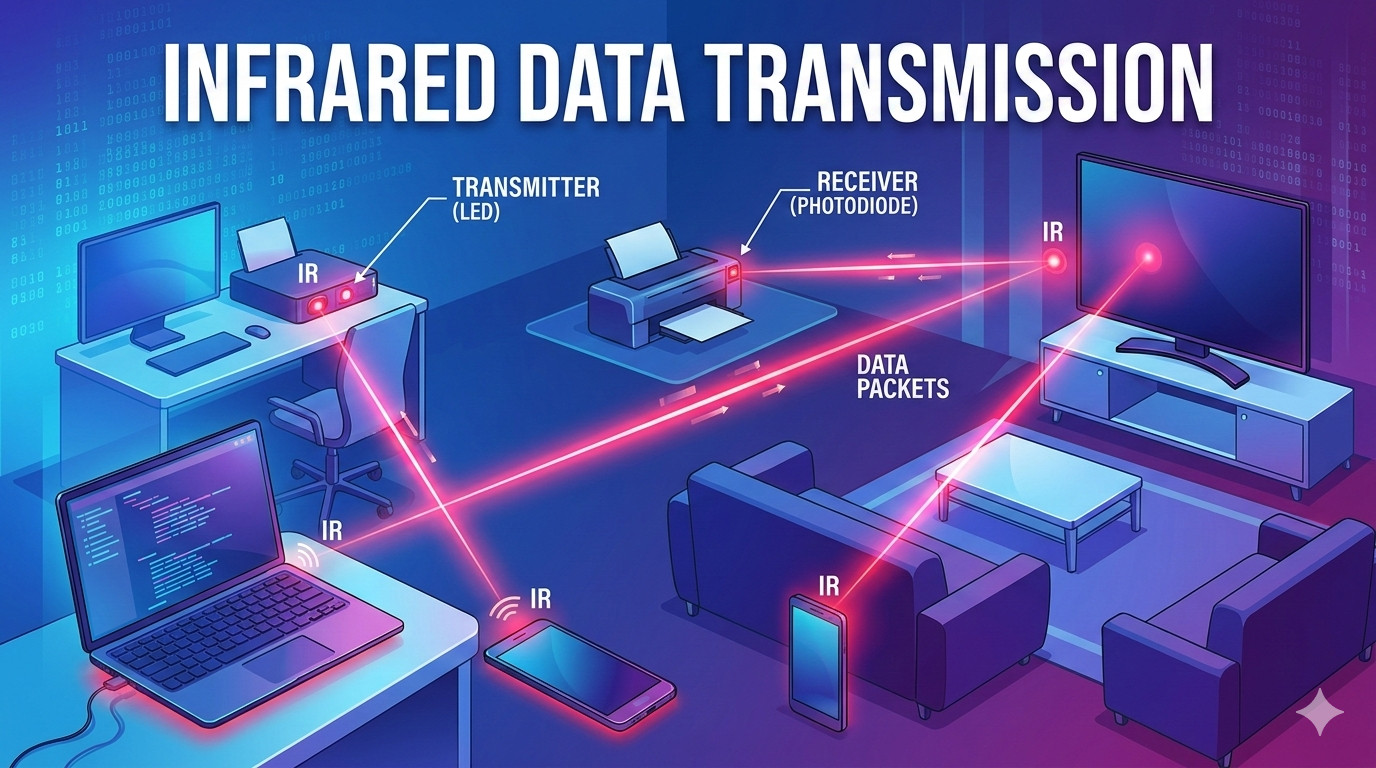
Infrared (IR) data transmission is one of the oldest and most elegant wireless communication technologies — invisible to the human eye, yet quietly powering everything from TV remotes to industrial sensors. While it may seem overshadowed by Wi-Fi and Bluetooth today, infrared remains a remarkably capable and reliable technology with a broad range of applications.
What Is Infrared Transmission?
Infrared light sits just below the visible spectrum, with wavelengths ranging from 700 nm to 1 mm. IR data transmission works by modulating a beam of infrared light to encode information, which is then detected by a photodiode or phototransistor on the receiving end.
The basic principle is straightforward:
- A transmitter (usually an IR LED) pulses light at a specific frequency.
- The pulses encode binary data — ones and zeros.
- A receiver detects the light and decodes the signal.
A Brief History
Infrared communication became popular in consumer electronics during the 1980s and 1990s. The introduction of the IrDA (Infrared Data Association) standard in 1994 was a turning point — it brought interoperability to IR communication, enabling laptops, mobile phones, and PDAs to exchange files wirelessly at speeds up to 4 Mbps (and later up to 1 Gbps with VFIR and Giga-IR standards).
Before Bluetooth arrived, IR was the go-to method for wireless file transfer between mobile devices.
How It Works: Key Standards
| Standard | Max Speed | Range | Year |
|---|---|---|---|
| SIR (Serial IR) | 115.2 Kbps | ~1 m | 1994 |
| FIR (Fast IR) | 4 Mbps | ~1 m | 1995 |
| VFIR | 16 Mbps | ~1 m | 2001 |
| Giga-IR | 1 Gbps | ~1 m | 2009 |
All IrDA standards require line-of-sight — the transmitter and receiver must face each other without obstruction.
Advantages of Infrared
- No interference with radio frequencies — IR is immune to RF noise and doesn’t interfere with aircraft or medical equipment.
- High security — the short range and line-of-sight requirement make interception very difficult.
- Low power consumption — ideal for battery-powered and embedded devices.
- No licensing required — IR operates in an unregulated part of the spectrum.
- Simple and inexpensive — IR LEDs and receivers are cheap, widely available components.
Limitations
- Line-of-sight only — walls, objects, or even a slight angle can break the connection.
- Short range — typically effective up to 1–5 meters.
- Affected by ambient light — bright sunlight or fluorescent lighting can cause interference.
- Low bandwidth compared to modern Wi-Fi or 5G standards.
Modern Applications
Despite competition from Bluetooth and Wi-Fi, infrared is far from obsolete:
- Remote controls — virtually every TV, air conditioner, and set-top box still uses IR remotes.
- Industrial automation — IR sensors detect objects on assembly lines and in robotics.
- Medical devices — pulse oximeters and thermometers use IR for non-contact measurements.
- Security systems — passive IR (PIR) motion detectors are standard in alarm systems.
- Optical fiber communication — infrared wavelengths (1310 nm, 1550 nm) are the backbone of modern fiber-optic internet.
- Free-space optical (FSO) communication — high-speed IR links connect buildings without laying cables.
LiFi: The Next Chapter
One of the most exciting modern developments is LiFi (Light Fidelity), which extends the concept of optical wireless communication using visible and infrared light. LiFi systems can theoretically achieve speeds exceeding 100 Gbps, offering a secure and high-bandwidth alternative to Wi-Fi in environments where radio frequencies are restricted.
Conclusion
Infrared data transmission may not dominate headlines, but its influence is everywhere — from the remote in your hand to the fiber cables carrying the internet across continents. Simple, secure, and interference-free, IR technology remains a vital tool in the engineer’s toolkit. And with innovations like LiFi pushing optical communication to new extremes, the future of infrared may be brighter than ever.