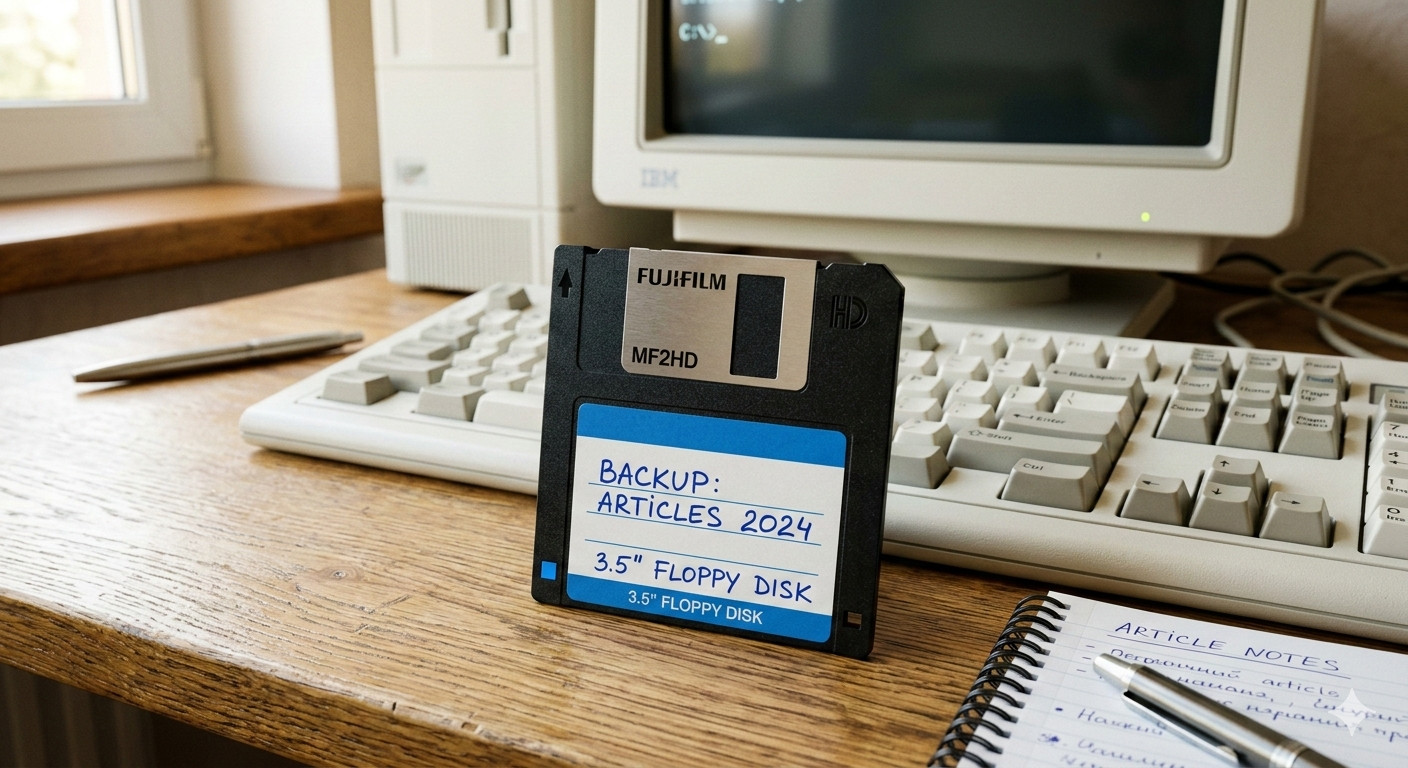
Before USB drives, cloud storage, and email attachments, there was the floppy disk. The 3.5-inch floppy disk, introduced in the early 1980s, became one of the most iconic and widely used data storage media of the 20th century. Though largely obsolete today, it left a lasting mark on computing history — and its silhouette lives on as the universal “Save” icon.
Origins and Development
The 3.5-inch floppy disk was developed by Sony in 1980 and officially introduced to the market in 1982. It was designed as an improvement over the older, larger floppy formats — the 8-inch and 5.25-inch disks — which were physically fragile and prone to damage.
The key innovation was the rigid plastic shell that encased the magnetic disk inside. Unlike its predecessors, the 3.5-inch floppy was genuinely portable and much harder to accidentally destroy. A sliding metal shutter protected the magnetic surface from dust and fingerprints when the disk was not in use.
Technical Specifications
The storage capacity of 3.5-inch floppy disks evolved over time:
| Format | Capacity | Era |
|---|---|---|
| Double Density (DD) | 720 KB | Early 1980s |
| High Density (HD) | 1.44 MB | Late 1980s–2000s |
| Extended Density (ED) | 2.88 MB | Early 1990s (rare) |
The 1.44 MB HD variant became the definitive standard and the one most people remember. It could store roughly 1.44 million bytes of data — enough for a few hundred text documents, though far too small for modern files like photos or videos.
Rise to Dominance
The format gained massive popularity after Apple adopted it for the Macintosh in 1984. IBM followed suit, and by the late 1980s, the 3.5-inch floppy had effectively replaced all other portable storage formats in personal computing.
Throughout the 1990s, floppy disks were the primary means of:
- Installing software and operating systems
- Transferring files between computers
- Distributing shareware and early video games
- Backing up important documents
It was common for major software packages — like early versions of Microsoft Windows — to come on a stack of a dozen or more floppy disks.
Decline and Legacy
The decline of the floppy disk began in the late 1990s. In 1998, Apple made a bold move by omitting a floppy drive from the original iMac G3, signaling that the format’s days were numbered. The rise of CD-ROMs, recordable CDs, and eventually USB flash drives offered far greater capacity and convenience.
By the mid-2000s, most PC manufacturers had stopped including floppy drives as standard equipment. Sony — the format’s original creator — officially ceased production of 3.5-inch floppy disks in 2011.
Despite its physical disappearance, the floppy disk’s legacy endures in one unexpected place: the 💾 save icon. In virtually every software application today, the icon representing “Save” is still a tiny picture of a 3.5-inch floppy disk — recognized by billions of people who have never used one.
Conclusion
The 3.5-inch floppy disk had a relatively short lifespan in technological terms, yet it played a crucial role in making personal computing accessible and practical for everyday users. It was the right product at the right time — compact, durable, and affordable. Today, it serves as a nostalgic symbol of an era when 1.44 megabytes felt like all the space in the world.