In the early days of computing, a computer was an island. It was a massive, room-sized machine that crunched numbers in solitude. If you wanted to share data with another computer, you didn’t send an email; you physically carried a magnetic tape or a stack of punch cards across the room—a method affectionately known as “Sneakernet.”
The evolution from these digital islands to the hyper-connected world of 2026 is a journey of military necessity, academic curiosity, and a few “Aha!” moments that changed history.
1. The Catalyst: Cold War Tension
The story begins in the late 1950s. Following the Soviet Union’s launch of Sputnik, the United States formed ARPA (Advanced Research Projects Agency). Their mission was to ensure US military technology stayed ahead. They needed a communication system that could survive a nuclear strike. If one “node” was destroyed, the information had to find another path to its destination.
2. The Breakthrough: Packet Switching
Before networks, communication relied on “circuit switching” (like old telephone lines), where a dedicated line was held open for the entire conversation. This was inefficient.
In the 1960s, pioneers like Paul Baran and Donald Davies conceptualized Packet Switching. Instead of sending a giant file in one piece, the data was chopped into small “packets,” sent through various routes, and reassembled at the finish line.
3. ARPANET: The First Connection
In 1969, the first message was sent between UCLA and the Stanford Research Institute. The message was supposed to be “LOGIN,” but the system crashed after the first two letters. Thus, the first message ever sent over a long-distance network was simply: “LO.” Despite the crash, the foundation was laid. By the 1970s, more universities joined the fray, and the network began to breathe.
4. The Universal Language: TCP/IP
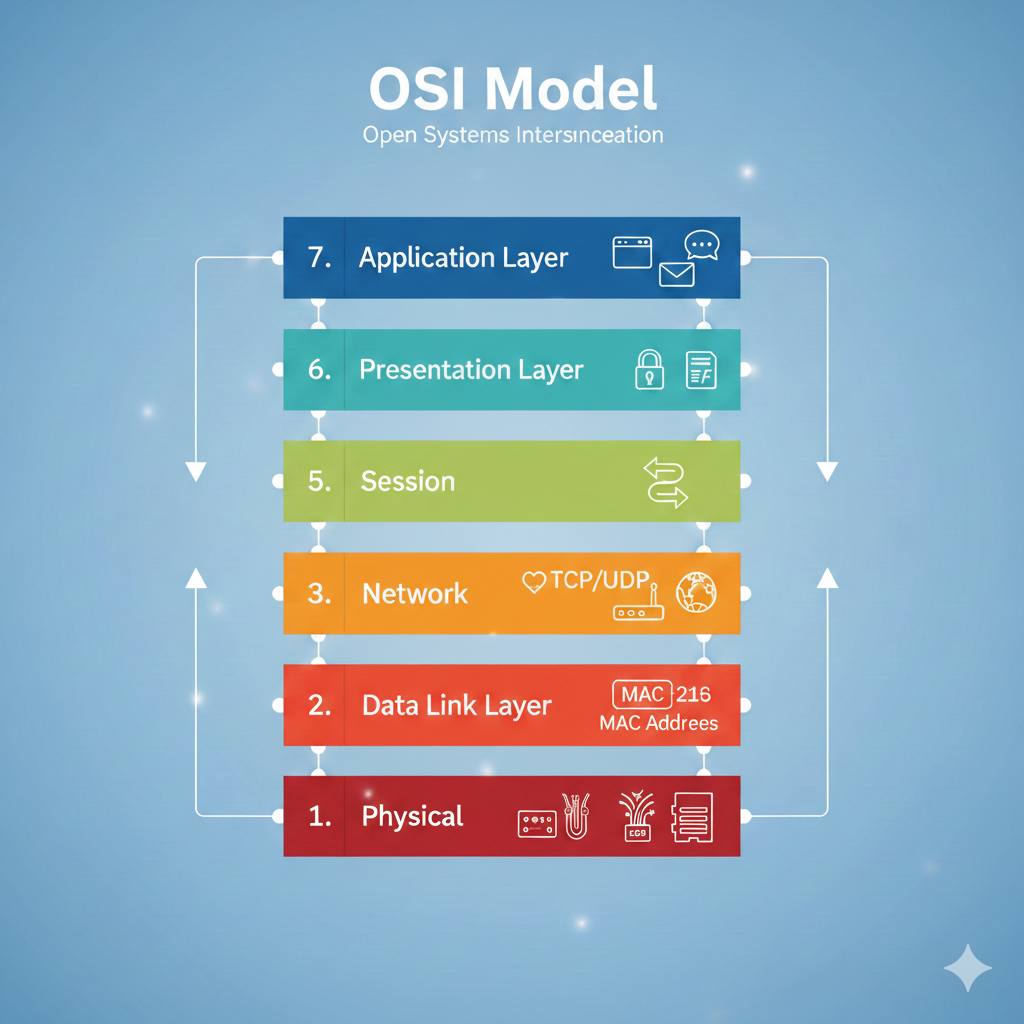
As different networks started popping up, they couldn’t talk to each other—they spoke different “languages.” In 1974, Vint Cerf and Bob Kahn developed the TCP/IP (Transmission Control Protocol/Internet Protocol). Think of it as the universal grammar of the internet. It allowed diverse networks to merge into a “network of networks”—the Internet.
5. The Final Frontier: The World Wide Web
Many people confuse the “Internet” with the “World Wide Web.”
- The Internet is the hardware, wires, and protocols (the tracks).
- The Web is the collection of websites and HTML pages we see (the train).
In 1989, Tim Berners-Lee, a scientist at CERN, invented the Web to help researchers share data effortlessly. He gave the technology away for free, sparking the digital gold rush of the 90s.
Why It Matters Today
Today, networking isn’t just about cables. We’ve moved into the era of 5G, Starlink satellite arrays, and the Internet of Things (IoT), where your fridge talks to your grocery app. We are no longer just “using” a network; we are living inside one.
The transition from “Sneakernet” to “Fiber-optics” proves one thing: humanity’s greatest innovations don’t come from faster processors, but from our desire to stay connected.